Finding Your Personal Legend: Why the Universe Might Be Conspiring for You
Join Phillip Jones and Grant Potts as they dive into Paulo Coelho’s The Alchemist to discuss destiny, choice, and the mystery of the “Personal Legend.”
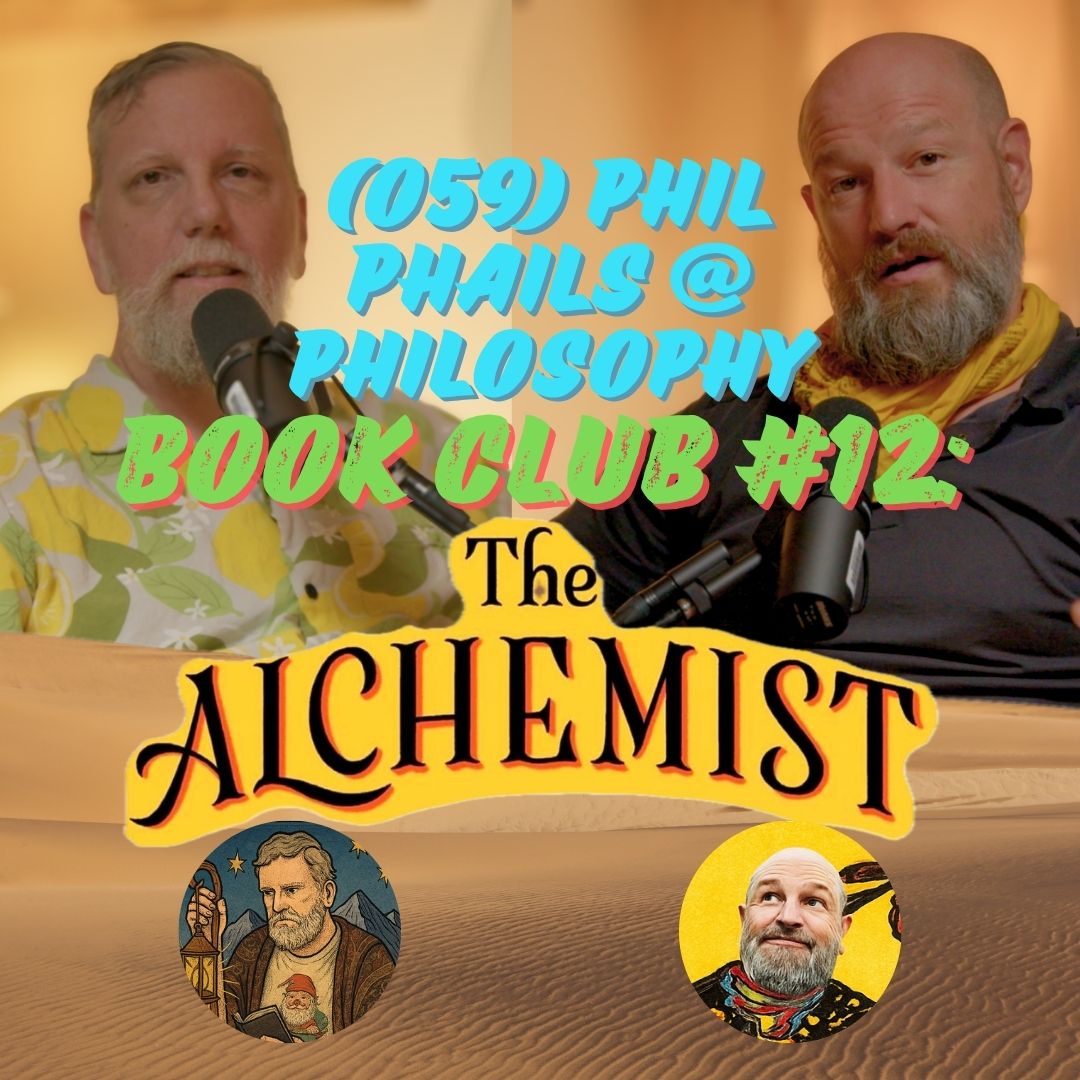
Have you ever felt like the universe was trying to tell you something, but you were too busy with the “day-to-day” to listen? That’s the tension we explored in our latest Phil Phails Book Club. I sat down with my partner in crime, Grant Potts—a philosophy and religion expert from Austin Community College—to tackle a book that has been a spiritual touchstone for millions: The Alchemist by Paulo Coelho.
If you’re interested in finding your personal legend, this conversation is for you. We didn’t just summarize the plot; we dug into the messy parts of growth, the fear of getting “robbed in the desert,” and whether “destiny” is actually just a fancy word for the choices we make.
The Tension Between Fate and Agency
One of the most famous lines in the book is, “To realize one’s destiny is a person’s own obligation.” Grant and I got hung up on this immediately. It’s a paradox, isn’t it? If something is your “destiny,” shouldn’t it happen inevitably?
But Coelho suggests that finding your personal legend requires skin in the game. You have an obligation to it. This implies that you could actually fail. You could choose to stay a shepherd. You could choose the “quotidian” (one of Grant’s favorite fancy words for “everyday”) life because it’s safe. Real growth happens at the “choice point” where you decide to move toward the thing you’re obligated to become.
Is the Universe Actually Conspiring for You?
We’ve all heard the quote: “When you want something, all the universe conspires in helping you achieve it.” It sounds great on a Hallmark card, but does it hold up in the real world?
Grant and I talked about how this idea functions as a psychological tool. If you assume the universe is helping you, it changes how you communicate and how you show up. When you project the life you want to live, the world starts to see you as that person. Gradually, opportunities and “omens” appear because you’ve finally tuned your antenna to receive them. Even if the “conspiring universe” is a bit of a myth, it’s a productive one that keeps you from collapsing when things get tough.
The Journey Back to Where You Started
The ending of The Alchemist is a bit of a “spoiler alert” classic: the treasure Santiago was looking for was back where he started. Does that make the journey a waste of time? Absolutely not.
The treasure isn’t just the gold under the tree; it’s the person Santiago became while crossing the desert, getting beaten up, and learning to read the wind. Sometimes, personal growth requires us to go on a “crazy journey” just to realize that the tools we needed were inside us the whole time. It’s hidden in plain sight, but you can’t see it until you’ve gained the perspective that only a struggle can provide.
Phillip’s Personal Reflection
What surprised me most about our talk was how much I resisted the “Hollywood” ending. Santiago gets the girl, gets the treasure, and everything is tied up in a neat bow. Part of me thinks, “Come on, life isn’t that clean.” But Grant challenged me to look at it differently. Maybe the “Hollywood” stuff is just the subplot. The real story is the transition from a “householder” life to one of active seeking. I realized that I often wait for a “sign” before I act, but the book argues that action is the sign. You don’t find your legend by waiting for it to arrive; you find it by being willing to fail at the first step.
Practical Takeaways
- Identify Your Choice Points: Recognize where you are choosing safety over your “Personal Legend.”
- Project Your Intent: Start communicating who you want to be. The world can’t help you if it doesn’t know what you’re seeking.
- Value the Struggle: The “thieves in the desert” moments are part of the curriculum. They aren’t distractions; they are the path.
- Look in Your Own Backyard: Often, the solution to your biggest problem is a skill or resource you already possess but have undervalued.
Conclusion
At the end of the day, The Alchemist isn’t a roadmap—it’s a mirror. It asks us if we’re brave enough to listen to our hearts even when the “omens” seem silent. Whether you believe in fate or just the power of a focused mind, the obligation to grow remains the same.