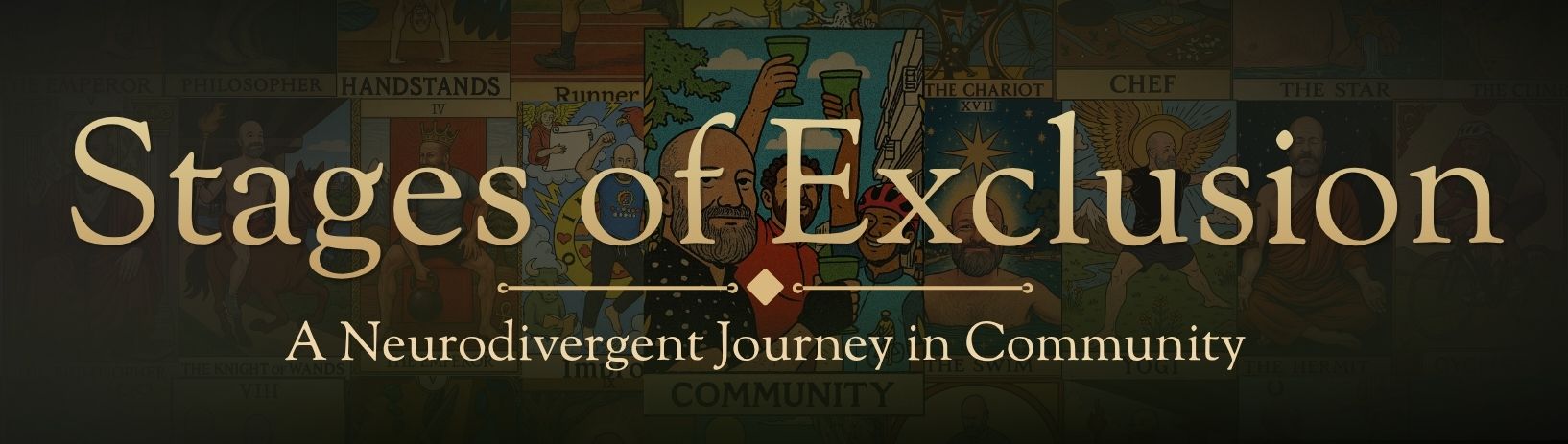
Purpose
This writing is both a reflection and an act of meaning-making. By looking back on what happened with this group, I hope to better understand the patterns of how rejection unfolds, to share openly the challenges that neurodivergent people face in communities that may not understand or embrace difference, and to offer insights that might help community organizers build spaces that are safer, more inclusive, and genuinely welcoming.
Title:
The Stages of Being Othered in Community: One Neurodivergent Story
From Hope to Agency—and What Communities Can Do Differently
Abstract
This work explores the lived experience of navigating community as a neurodivergent person, tracing the seven stages from hopeful entry to exclusion, grief, and ultimately agency and rebuilding. Through a personal narrative of joining and later being pushed out of a cycling group, it illuminates the subtle and overt dynamics of misattunement, bias, conflict, and rejection that too often shape neurodivergent belonging. At each stage, practical “community notes” highlight alternative approaches that foster inclusivity, transparency, and care. Readers will come away with both a deeper empathy for the challenges neurodivergent individuals face in communities and a roadmap for building healthier, more resilient groups.
Introduction – Mapping the Journey of Community and ADHD
Belonging is one of the deepest human needs. For those of us with ADHD, it can also be one of the hardest to hold onto. Our intensity, honesty, impulsivity, or differences in communication style often collide with the unspoken rules of groups. What might start with optimism and excitement can unravel into confusion, rejection, or shame.
This book is my attempt to chart that cycle—both personally and scientifically. It is born from my experiences in community, especially with my local bike group ride, where I felt the promise of belonging but also the pain of exclusion. Writing about these experiences is part of my own Stage 7: Agency & Rebuilding—a process of making sense, integrating lessons, and building new pathways toward healthier forms of belonging.
The Tension Between Accountability and Belonging
One of the questions at the heart of this project is: Where does personal accountability meet communal acceptance?
On the one hand, I know I must take responsibility for my own actions, communication, and impact. Growth requires honesty about where I fall short, and the courage to repair when I hurt others. Accountability is not optional—it’s essential.
On the other hand, accountability alone cannot create belonging. Communities also carry responsibility: to be inclusive, transparent, and fair. For neurodivergent people especially, the need is not for perfection but for acceptance—to be seen as whole human beings who can learn, repair, and grow without fear of banishment.
This book lives in that tension. It is about my struggle to balance personal accountability with the longing for societal and communal acceptance. When those two forces work together, they create conditions for growth and resilience. When they clash, exclusion and shame follow.
I do not enter this conversation lightly. I have spent decades in therapy, coaching, workshops, leadership programs, communication trainings, and spiritual practice. From co-parenting therapy to Dialectical Behavior Therapy, from Nonviolent Communication to Radical Honesty, from Circling to ketamine-assisted psychotherapy, from Zen meditation to men’s groups—if accountability is about “doing the work,” then I have done the work. These experiences did not immunize me from conflict, but they did give me a deeper appreciation of how difficult—and how necessary—it is to hold both sides of the equation: the personal responsibility to grow and the communal responsibility to include.
The Structure of Each Stage
Each stage in this book follows a consistent format, weaving together lived experience, science, and tools for growth:
- Subjective Experience – My personal story, centered on my time with the bike group ride community, illustrating how ADHD traits and group dynamics played out in real time.
- Objective Deep Dive – An exploration of psychological and neuroscientific research related to the dynamics of that stage, with a focus on ADHD-specific angles.
- Reflection Questions & Exercises – Practical tools for self-exploration and skill-building, so readers can connect the science to their own journey.
- Further Reading – Curated, annotated recommendations to extend the learning and offer perspectives from psychology, sociology, and lived experience.
This rhythm—subjective, objective, reflective, expansive—mirrors the cycle of learning itself: experience, sense-making, practice, integration.
The Stages of the Journey
The book unfolds across seven stages of community experience, especially as they intersect with ADHD:
- Stage 1: Hope & Entry – The thrill of finding a new group, the promise of belonging, and the optimism that ADHD can fuel.
- Stage 2: Micro-Misattunements – Small misunderstandings and subtle disconnects that, left unaddressed, start to erode trust.
- Stage 3: Escalation – Misattunements stack up; patterns harden; tensions rise.
- Stage 4: Conflict / Rejection – Clashes or confrontations surface; the ADHD brain’s challenges with emotional regulation often sharpen the rupture.
- Stage 5: Exclusion – Subtle or explicit forms of ostracism, “time-outs,” or banishment; the profound neurological and emotional impact of being cut off.
- Stage 6: Withdrawal, Grief & Meaning-Making – The fallout of exclusion, the process of metabolizing grief, and the search for meaning in the loss.
- Stage 7: Agency & Rebuilding – Taking responsibility, regaining agency, and discerning the kinds of communities worth committing to in the future.
Deep Dives Along the Way
In addition to the seven stages, the book includes focused essays where we pause to dig deeper into patterns that cut across multiple stages. These are moments to zoom out and reconsider the frameworks themselves, such as:
- Rethinking “Time-Out” — From Calling Out to Calling In – A critical look at punitive models of accountability in communities, and alternatives that foster growth and repair.
- Framing & Reframing – Choosing the Lens That Heals – How cognitive framing shapes our sense of belonging, rejection, and resilience.
- Personal Accountability – Where Growth Meets Belonging – A meditation on the balance between self-responsibility and the communal responsibility of acceptance, especially in the context of ADHD and neurodivergence.
Why This Book
This is not just a book about ADHD, nor just a book about community. It is about the intersection where the ADHD brain and group belonging collide—sometimes beautifully, sometimes painfully. My hope is that by sharing my own story alongside the science, I can illuminate patterns many of us experience but rarely name.
Most importantly, this book is about possibility. Each stage, even exclusion and grief, contains within it the seeds of agency, growth, and rebuilding. The journey is not linear; we cycle through stages again and again. But with awareness and tools, we can return more quickly to belonging—both within ourselves and with others.
Stage 1 – Hope & Entry
For neurodivergent people, entering a new community often begins with immense courage. After repeated experiences of rejection—whether in school, sports teams, workplaces, or social groups—it takes a remarkable amount of bravery, or sometimes a kind of hopeful amnesia, to once again step forward and seek friendship and belonging. The science supports this reality: neurodivergent individuals face exclusion, rejection, and negative social cues at significantly higher rates than neurotypical peers. Over time, these repeated wounds deeply shape self-perception and worldview, often leaving people isolated and questioning their place in society.
For me, the pain of exclusion is not abstract—it is personal and ongoing. I have been pushed out of nearly every group I’ve tried to join. It hurts each time. Still, I return, because the human need for community doesn’t vanish. In July 2024, I gathered my courage again and joined a July 4th group ride at a local bike shop. I felt a lot of excitement and happiness on arrival. A close friend of mine invited me, so I had some familiar support. At the same time, I experienced a degree of anxiety and nervousness about meeting new people and participating in a group ride for the first time.
From the beginning, there were consistent words of encouragement and support: “You can do it!”, “You are stronger than you think you are,” “Good job.” I also experienced gestures of care, such as riders waiting for me at the top of a hill or riding alongside me when I was dropped from the group. These words and actions made me feel cared for and part of the group. Over time, the generosity intensified in ways that were both uplifting and confusing. After my tires deteriorated, community members provided replacements and helped maintain my bike. One of the leaders donated items to the shop, which were then given to me to help me keep up with the group. They provided a full road cycling kit, socks, shoes, and sunglasses and even a bike computer. I worried about the strings attached and wondered, “What do they want from me?” and “Why are they doing this?” When I was assured that they simply wanted me to succeed and belong, I felt joy, happiness, and excitement. I had found a place where I felt accepted.
Even in these early stages, I masked certain aspects of myself. I didn’t attend other rides or shop events, nor did I linger at the shop. A lifetime of challenges and rejection in group settings had left me with a low-level anxiety and caution, with persistent questions like, “Would I be accepted?” and “Can I belong here?” Looking back, I may have missed early signs that belonging could be conditional.
The experience of being neurodivergent added another layer of complexity. I often struggled with social cues but was quick to categorize people as friends or safe, which sometimes led to misunderstandings. Two members of the same group might say similar things, but one receives laughs, acceptance, and positive feedback, while the other is met with offense, requests to change, or negative feedback. The difference is not in the content shared but in the relationships present. This mismatch left me confused. Group bike rides, at least as I understood them, were supposed to be inherently social: talking, making friends, getting to know fellow riders. Yet I was told by ride leaders that I “talked too much.” What felt like normal, even essential, social engagement was reframed as a problem when it came from me. My open-hearted desire to participate and connect was being recast as inappropriate, disruptive, or excessive. This marked the beginning of a painful reframing: my presence and contributions were interpreted not by my intent, but through a negative lens applied by community leaders.
Looking more broadly, research shows that neurodivergent individuals often experience social exclusion, subtle bias, and misunderstanding in group settings. Patterns of rejection, misattunement, and differential responses to social behavior are common, making early engagement both thrilling and precarious. Recognizing these dynamics is key to fostering inclusive communities and understanding the lived experience of neurodivergent people navigating new social spaces.
Community note – try this instead
When a new member arrives, particularly someone from a historically excluded group, communities can:
- Offer explicit welcomes to new members rather than leaving belonging to chance.
- Pair newcomers with a peer guide or “buddy” to explain norms, reduce ambiguity, and provide relational support.
- Signal clearly that difference is valued, not just tolerated, so newcomers understand that unique perspectives and communication styles are appreciated.
- Normalize variation in social behavior: some members are more talkative, some more quiet, and both are welcome.
- Provide opportunities for newcomers to express comfort levels around conversation versus silence on rides.
- Check in privately before framing someone’s social style as a “problem,” offering guidance in a caring, supportive way rather than assigning blame.
- When showing generosity or giving gifts, clarify that these acts are meant to support success and inclusion, not to create obligation or pressure.
- Cultivate a balance between encouragement and clear expectations, emphasizing relational care, trust, and excitement for participation.
- Be mindful of neurodivergent differences: heightened sensitivity to social cues or misinterpretation of relational signals is common, and intent should not be assumed to harm.
- Embed empathy, clear communication, and structured pathways for inclusion to create safer, more welcoming environments that foster lasting connection.
The Science of Entry & Belonging – Why First Impressions Matter So Much
Entering a new group is never neutral — it is charged with biology, psychology, and history. For neurodivergent individuals, including those with ADHD, autism spectrum conditions, or other social-cognitive differences, the first moments in a new community can feel like walking a tightrope: hopeful, thrilling, but also intense and high-stakes. Integrating current research helps explain why these early experiences can feel overwhelming and how communities can foster safer, more welcoming entry points.
The Biology of Belonging
Human beings are wired for connection. Neuroscientist Matthew Lieberman describes the social brain as the “default network” — active even when we are not focused on a task. Feeling included triggers oxytocin and dopamine release, fostering trust, safety, and reward. Conversely, social rejection activates neural pathways overlapping with physical pain (Eisenberger & Lieberman, 2004).
Neurodivergent individuals may experience these processes differently. ADHD research shows heightened emotional reactivity and increased sensitivity to social feedback (Shaw et al., 2014; Surman et al., 2013). Autistic individuals may interpret social cues differently, which can magnify the perceived intensity of inclusion or rejection (Chevallier et al., 2012). Micro-moments — being ignored, side-glanced, or subtly criticized — can trigger disproportionate stress responses, increasing anxiety and reducing engagement.
Hope & Risk – The Double-Edged Entry
Brené Brown’s work on vulnerability underscores that connection requires risk. For neurodivergent individuals, past experiences of rejection create anticipatory threat — the expectation of harm in social contexts — which can make new encounters feel high-stakes even when environments are neutral or supportive. ADHD and autistic populations are more prone to social anxiety in novel group settings, compounding the cognitive load of interpreting norms, cues, and expectations.
Conditional vs. Unconditional Welcome
Research on belonging (Walton & Cohen, 2007) shows that early signals of conditional acceptance — “You can stay if you do everything perfectly” — increase anxiety, reduce performance, and raise dropout risk. Unconditional belonging fosters trust, learning, and persistence. Neurodivergent individuals may be particularly attuned to conditional cues and may internalize them as evidence of unworthiness, increasing the likelihood of masking or withdrawal.
The Halo & Horn Effect
Even in Stage 1, cognitive biases shape perception. The halo effect — where one positive trait colors all judgments favorably — and the horn effect — where one negative trait casts a shadow — are amplified in neurodivergent contexts. For example, a neurodivergent person may hyperfocus on a task or speak candidly; while peers might see these behaviors as inappropriate (horn effect), other members might interpret the same traits as leadership or creativity (halo effect). Understanding these biases is key to interpreting feedback fairly and designing inclusive group norms.
Masking & The Cost of Entry
Many neurodivergent individuals “mask” their authentic behaviors to fit in. Hull et al. (2017) document that masking can lead to exhaustion, anxiety, and identity stress. For ADHD and autistic members, masking may involve suppressing natural conversational styles, movement tendencies, or hyperfocus behaviors. Early community entry often requires intense masking, and when acceptance is conditional, the psychological cost of entry can become unsustainable, risking burnout or disengagement.
Creating Safe Landing Zones
Amy Edmondson’s research on psychological safety highlights that groups signaling “it’s safe to show up as yourself and make mistakes” achieve higher learning, performance, and retention. For neurodivergent individuals, creating these zones is especially impactful. Practical strategies include:
- Greeting new members warmly and consistently.
- Making expectations explicit and clear.
- Providing early, specific encouragement focused on effort, growth, and inclusion rather than conformity.
- Actively monitoring for subtle exclusionary cues (e.g., side conversations, inside jokes) that may disproportionately affect neurodivergent participants.
Reframing the Story of Entry
Neurodivergent people may be prone to interpreting anxiety or uncertainty as evidence of inadequacy. Reframing helps shift perspective:
Instead of:
“I feel nervous, so something must be wrong.”
Try:
“I feel nervous because this matters to me — and that’s a sign of courage and engagement.”
Similarly, when offered support — gear, guidance, or inclusion — reframing prevents misinterpretation of motives:
Instead of:
“They must expect something from me.”
Try:
“This is what healthy community looks like — people supporting one another’s success and growth.”
By integrating neurodivergent research and awareness into the science of entry, we can better understand why initial group experiences are both potent and precarious, and how intentional strategies can foster belonging, trust, and resilience.
Reflection Questions & Exercises
1. Mapping the Incident (Awareness & Context)
- What exactly happened during the conflict or rejection?
- Which behaviors or words were directed at you, and which were interpretations or assumptions?
- Who else was involved, and what role did bystanders play?
Exercise: Create a timeline of the events to separate observable facts from your interpretations or emotional reactions.
2. Identifying Cognitive & Emotional Patterns
- How did the experience trigger past memories of exclusion or criticism?
- Were there recurring themes in how leaders framed your actions (e.g., blame, personal attacks, hypocrisy)?
Exercise: Journal your immediate thoughts and feelings using a split-page method: facts on one side, emotions and interpretations on the other.
3. Recognizing Trauma Responses
- Did your body react physically (e.g., tension, racing heart, nausea)?
- Were you responding from a learned trauma pattern, such as hyper-vigilance or self-blame?
Exercise: Practice mindful observation of your body and breath during conflict-related memories, as suggested by van der Kolk’s trauma-informed approach.
4. Practicing Nonviolent Communication (NVC)
- What feelings and needs were triggered by the conflict?
- How could you express these without blame while still advocating for yourself?
Exercise: Using Rosenberg’s NVC framework, write one statement per conflict incident: Observation → Feeling → Need → Request. Example:
“When I was yelled at on the ride (observation), I felt embarrassed and unsafe (feeling). I value respect and clear communication (need). Would you be willing to clarify expectations for group rides (request)?”
5. Reframing & Emotional Agility
- How might you reframe the conflict as an opportunity for learning or boundary-setting rather than a personal failure?
- What is within your control versus outside it?
Exercise: Apply Susan David’s “emotional agility” by labeling emotions without judgment and identifying actionable steps you can take to protect yourself or repair the relationship.
6. Repair & Restoration
- Could dialogue or restorative practices help mend the relationship or clarify misunderstandings?
- If yes, what approach would be safe and constructive?
Exercise: Draft a restorative conversation plan inspired by Howard Zehr: outline what happened, the impact, and what would make amends meaningful.
7. Self-Compassion & Radical Acceptance
- How can you hold space for your own hurt without self-judgment?
- What practices could help you integrate this experience without lingering shame or resentment?
Exercise: Follow Tara Brach’s guided reflection on radical acceptance: silently repeat, “It’s okay that I feel this way. I am learning to respond with compassion and clarity.”
Further Reading
Entering a new community after a history of rejection can feel like walking a tightrope — exhilarating, hopeful, and terrifying all at once. The works below offer insight into why social connection is so powerful, why rejection hurts as much as it does, and how we can care for ourselves while building belonging. Together, they illuminate both the science and the inner work required to navigate this vulnerable stage.
Matthew Lieberman, PhD – Social: Why Our Brains Are Wired to Connect
An accessible introduction to the neuroscience of connection. Explores how belonging is a basic human need and why rejection hurts as much as physical pain.
Brené Brown, PhD – Daring Greatly
A deep dive into vulnerability and courage. Shows why the act of showing up in new groups is inherently risky — and how embracing that risk builds real connection.
Gregory Walton & Geoffrey Cohen – A Brief Social-Belonging Intervention Improves Academic and Health Outcomes of Minority Students (Journal of Personality and Social Psychology, 2011)
Landmark research shows that even small interventions that affirm belonging can dramatically improve engagement, persistence, and well-being in new environments.
Amy Edmondson, PhD – The Fearless Organization
Explores the concept of psychological safety — creating spaces where people feel free to speak up, make mistakes, and be themselves without fear of rejection or humiliation.
Laura Hull et al. – “Putting on My Best Normal”: Social Camouflaging in Adults with Autism Spectrum Conditions (Journal of Autism and Developmental Disorders, 2017)
Foundational paper on masking, describing why neurodivergent individuals hide their authentic behaviors and the emotional toll it takes over time.
Daniel Kahneman – Thinking, Fast and Slow
Includes a clear explanation of the halo and horn effects, showing how early impressions shape judgment — and why those first interactions in a community matter so much.
Stage 2 – Micro-Misattunements
The first cracks in belonging were small, almost imperceptible at first. I began hearing comments that I was “talking too much” during rides. Sometimes it was framed as if my talking meant I wasn’t riding hard enough—because if I were pushing myself to the limit, I’d be too out of breath to speak. These remarks were half-joking, but they carried an undertone of correction: my way of engaging, of making the ride social, was already beginning to stand out.
One of the earliest and clearest frictions happened when I invited a few ride leaders and others to a friend’s coffee shop pop-up. During casual joking, another rider and I teased that one of the leaders was secretly a billionaire or part of a historically wealthy Jewish family. I thought we were all playing along, weaving humor around popular clichés. I assumed his momentary offense was feigned, part of the gag, so I continued. Later, as we rode home, he told me directly that he was truly offended, especially since I kept going after he expressed discomfort. I was shocked—I immediately apologized and reassured him that I wasn’t anti-Semitic, that my intention had been humor, not harm. Still, the damage was done.
Moments like this planted seeds of anxiety and anger in me. I began noticing what felt like a double standard. Two people could say the same type of joke, and the responses would be completely different. Some riders got laughs, acceptance, and encouragement. My jokes, even when framed in the same style, could trigger disapproval or warnings to “watch my behavior.” One ride leader even suggested that I had offended a female rider, positioning himself as her protector. But when I asked her directly, she said she hadn’t been offended at all—and that if she ever was, she’d tell me. This mismatch between what I was told and what people actually felt left me confused and wary.
There were also moments where the group made jokes steeped in “locker room” culture—casual gay humor, innuendo, and ribbing—that overlapped with the exact kinds of jokes I was told to avoid. The inconsistency was disorienting. It wasn’t about the content of the humor, I realized, but about who was saying it and whether they already had relational capital within the group.
Looking back, I can see how uncomfortable it felt to have my normal social behavior reframed as a problem. Bike rides, at least as I understood them, were inherently social: a chance to talk, make friends, and connect. Yet my open-hearted participation—banter, joking, conversation—was recast as “too much,” “inappropriate,” or “disruptive.” It was the beginning of a painful shift where my intentions mattered less than the negative lens others applied.
As someone who is neurodivergent, this stage was especially tricky. Research shows that autistic and ADHD individuals often struggle to interpret subtle social cues, like whether someone is joking or actually upset (Morrison et al., 2019; American Psychiatric Association, 2013). Neurodivergent people may also be more likely to quickly categorize someone as a “friend,” assuming safety where others may still hold reservations. This cognitive orientation can make misunderstandings almost inevitable—not from ignorance or malice, but from differences in perception and processing.
At the same time, my history with therapy, men’s groups, and self-work gave me tools to interpret events in a positive light. For a while, I could reframe, brush off discomfort, and keep trying. But the repeated double standards and subtle corrections chipped away at me. Instead of being carefree, my participation began to feel cautious, even self-conscious.
My coping strategies became about proving my worth. I rode harder and more frequently, hoping performance would earn me belonging. I couldn’t afford a top-tier bike, but I could log miles, show up consistently, and build fitness. Inside, though, I also started questioning myself. Was I truly connecting, or just trying too hard? Was my humor out of place, or was the group unwilling to see me as one of them? The questions lingered like shadows, marking the fragile beginning of exclusion.
Community note – try this instead
- Clarify norms early. If talking is discouraged during hard efforts, leaders should state this openly as a ride norm rather than framing it as a personal flaw.
- Be consistent in feedback. Apply the same standards for jokes, banter, and social talk across members. Inconsistency breeds confusion and erodes trust.
- Address offense relationally, not politically. If someone feels offended, feedback should come directly from that person—not triangulated or filtered through others. This avoids “white-knighting” or projecting offense on behalf of others.
- Differentiate intent from impact. Leaders can acknowledge good intent while still explaining impact, creating space for accountability without labeling someone as malicious.
- Recognize the neurodivergent layer. Understand that some members may misread cues or persist in a joke because they assume playful engagement. Training in neurodiversity awareness can reduce misinterpretations.
- Favor “call-in” practices. Instead of reframing someone’s behavior negatively in front of the group, approach them directly with empathy and curiosity.
- Acknowledge power dynamics. When leaders joke in the same style they forbid others to use, it creates a double standard. Leaders set the tone—consistency matters.
- Build feedback loops. Clear, direct, and timely communication between members prevents misunderstandings from festering into conflict.
The Science of Micro-Misattunements – How Small Signals Shape Belonging
Stage 2 introduces the first cracks in social cohesion. While Stage 1 focused on entry and initial welcome, Stage 2 highlights the subtle, almost invisible cues that signal difference, disapproval, or conditional acceptance. These micro-misattunements — minor comments, inconsistencies, or differential treatment — can have an outsized impact on neurodivergent individuals, shaping their perception of belonging, safety, and trust.
Subtle Social Cues and Neurodivergent Sensitivity
For neurodivergent individuals, interpreting social cues can be challenging. ADHD research indicates heightened emotional reactivity, impulsivity, and difficulty filtering competing social signals (Shaw et al., 2014; Surman et al., 2013). Autistic research similarly shows that social perception is often context-dependent, making it hard to distinguish joking from criticism (Morrison et al., 2019). In a community setting, even small, inconsistent cues — a teasing comment, an expression of mild annoyance, or a side remark — can feel significant or threatening.
Neurodivergent individuals may also categorize people quickly as “safe” or “friendly,” sometimes overestimating relational safety. When early assumptions clash with social norms or unspoken hierarchies, misunderstandings arise. This aligns with research on theory of mind differences in ADHD and autism, which can affect interpretation of intentions and nuanced social feedback (American Psychiatric Association, 2013; Antshel et al., 2016).
The Cumulative Weight of Micro-Misattunements
While any single comment or action may seem minor, repeated micro-misattunements compound. Neuroscience shows that chronic exposure to subtle social stressors activates the amygdala and stress pathways (Arnsten, 2009). For neurodivergent individuals, this can heighten vigilance, anxiety, and self-monitoring. The experience of being “too talkative,” or being corrected inconsistently while observing others get away with similar behaviors, triggers both confusion and self-doubt.
Double Standards and Social Hierarchies
Research on social hierarchies and ingroup bias shows that groups unconsciously favor those with relational capital, shared history, or markers of prestige, while outsiders are judged more harshly (Tajfel & Turner, 1979). In neurodivergent contexts, where social decoding may require additional cognitive effort, these biases are amplified. ADHD individuals, in particular, may hyperfocus on rules and fairness, perceiving double standards acutely and internalizing them as personal failure (Barkley, 2015).
Humor, Social Risk, and Misalignment
Social humor provides bonding opportunities, but also carries risk. Misalignment between perceived and intended humor can quickly trigger conflict, especially for neurodivergent participants who may rely on literal or rule-based interpretations (Chevallier et al., 2012). When the same type of joke is received differently depending on who says it, it reinforces the sense of conditional belonging — that acceptance is earned, not inherent.
Coping, Masking, and Overcompensation
As misattunements accumulate, neurodivergent individuals may engage in compensatory strategies: masking, hyper-performance, or over-conforming. Hull et al. (2017) document that masking is mentally and physically exhausting, particularly when combined with the emotional effort of navigating inconsistent social feedback. ADHD research highlights that individuals may also overcompensate through hyperfocus or striving for visible achievement, attempting to earn acceptance through performance (Shaw et al., 2014).
The Neuroscience of Social Stress
Repeated micro-rejections or ambiguous corrections can chronically activate stress circuits in the brain. Elevated cortisol and amygdala hyperactivity influence both mood regulation and attention, which may exacerbate ADHD-related challenges in sustaining focus and interpreting complex social dynamics (Arnsten, 2009; Surman et al., 2013). Over time, this can erode intrinsic motivation and make participation feel like a high-stakes performance rather than a shared, enjoyable experience.
Practical Implications for Community Design
Understanding micro-misattunements and their outsized impact on neurodivergent members informs actionable strategies:
- Clear, explicit norms: Make social expectations concrete rather than implied.
- Consistent feedback: Avoid double standards; provide uniform guidance to all members.
- Psychological safety signals: Acknowledge errors as learning opportunities, not personal failings.
- Support relational navigation: Offer mentors or social liaisons to help neurodivergent members interpret cues and reduce uncertainty.
By recognizing the science behind micro-misattunements and the unique neurodivergent experience, communities can mitigate early relational fractures and create environments where curiosity, humor, and engagement are met with understanding rather than misinterpretation.
Reflection Questions & Exercises
- Mapping the Micro-Moments (Awareness & Context)
- What exactly happened during the subtle friction or misattunement?
- What words, jokes, or signals were directed at you — and which were interpretations you filled in?
- Who else was present, and how did they respond (laughter, silence, side comments)?
Exercise: Write a short timeline of 2–3 misattunement moments, separating what was actually said or done from your emotional reaction or assumptions.
- Identifying Cognitive & Emotional Patterns
- Did you notice repeated themes — being told you talk too much, not pushing hard enough, or that your humor was inappropriate?
- How did these experiences echo past experiences of correction or disapproval?
Exercise: Use a split-page journal method: on the left, record the group’s behavior; on the right, write your feelings, thoughts, and self-talk about what happened. Look for recurring words or emotional patterns.
- Recognizing Masking & Social Exhaustion
- Did you start changing how you spoke, joked, or interacted to avoid negative feedback?
- Did you leave rides feeling more drained than energized?
Exercise: After your next group interaction, rate your energy from –5 (drained) to +5 (energized). Keep a running log for a week and notice if masking correlates with fatigue.
- Exploring Double Standards & Fairness Sensitivity
- When did you notice that similar behaviors were accepted from others but criticized when you did them?
- How did these moments affect your sense of safety and trust?
Exercise: For each double-standard moment, write:
* What happened
* How you felt
* What meaning you assigned to it
Then, add 1–2 alternative interpretations to loosen the grip of a single story.
- Practicing Nonviolent Curiosity
- What questions could you ask (gently and privately) to clarify misunderstandings before they build up?
- How can you seek repair without escalating tension?
Exercise: Draft one clarifying question per incident using an NVC-inspired frame:
“When [specific behavior] happened, I felt [emotion]. Can you help me understand what was expected or how I might approach this differently next time?”
- Reframing & Emotional Agility
- Could these early frictions be signals about group culture rather than proof that you’re defective?
- What might these moments teach you about your own needs for safety, humor, or connection?
Exercise: Write one reframe per event, e.g.,
* Instead of: “I talk too much.”
* Try: “I value connection, and this group may have different norms around socializing.”
- Self-Compassion & Validation
- How can you remind yourself that being corrected or misinterpreted does not make you unworthy?
- What practices bring you back to a sense of grounding and self-trust?
Exercise: Practice a self-compassion mantra before and after group rides:
“It’s okay to take up space. I’m allowed to learn. My worth isn’t defined by perfect behavior.”
Further Reading
Stage 2 explores the small but powerful moments that shape belonging — micro-misattunements, subtle social corrections, and inconsistent feedback that can feel amplified for neurodivergent individuals. These experiences often occur before any explicit exclusion or conflict, yet they lay the groundwork for later rupture. The readings below offer a mix of neuroscience, psychology, and practical guides to understanding these early cracks. They include perspectives on group dynamics, humor, fairness, masking, and how ADHD and autistic brains process subtle social signals. Together, they provide a deeper lens for recognizing when the “invisible social contract” is at play — and for developing self-awareness and skills to navigate it.
Judith E. Glaser – Conversational Intelligence
Explores how even small shifts in tone, word choice, or feedback can trigger threat responses or build trust, offering insight into why micro-misattunements feel so significant.
Bessel van der Kolk – The Body Keeps the Score
Although focused on trauma, van der Kolk’s work illuminates how small, repeated relational ruptures can dysregulate the nervous system over time, particularly in those with heightened sensitivity.
Devon Price – Unmasking Autism
Offers a powerful look at how neurodivergent people learn to mask and perform to fit social norms, and what it costs them emotionally and physically.
Thomas Henricks – Play and the Human Condition
Examines the role of play, humor, and social risk-taking in human connection — helpful for understanding why joking and banter are both bonding tools and potential flashpoints.
Daniel Kahneman – Thinking, Fast and Slow
Kahneman’s exploration of cognitive biases provides insight into how snap judgments and group hierarchies influence whether behavior is read as playful or problematic.
Haim Omer – Nonviolent Resistance: A New Approach to Violent and Self-Destructive Children
While aimed at families, Omer’s emphasis on “presence” over control offers a model for relational accountability without shaming or punitive escalation — directly relevant to group correction moments.
Kristin Neff & Christopher Germer – The Mindful Self-Compassion Workbook
Includes practical exercises for self-kindness when experiencing small rejections or misattunements, helping to reduce shame and maintain perspective.
Gordon Allport – The Nature of Prejudice
Classic work on ingroup/outgroup bias that explains why certain members of a group are afforded more latitude, while others face greater scrutiny.
Hull et al. (2017) – “Putting on My Best Normal”: Social Camouflaging in Adults with Autism Spectrum Conditions (Journal of Autism and Developmental Disorders)
This peer-reviewed paper details the exhausting mental labor of masking, a key coping strategy often triggered by micro-misattunements.
Arnsten, A. F. T. (2009) – “Stress signalling pathways that impair prefrontal cortex structure and function.” (Nature Reviews Neuroscience)
Essential neuroscience research on how chronic social stress diminishes cognitive flexibility, amplifying emotional reactivity — a mechanism highly relevant to ADHD and micro-rejection.
Stage 3 – Escalation
In this stage, the dynamics shifted from subtle friction to something more damaging: the way leadership and other community members began to interpret and influence how my behavior was seen. A powerful cognitive bias was at play here—the halo effect. Within the bike shop and group ride culture, certain traits created a “halo”: owning an expensive bike, spending significant money at the shop, or riding with impressive speed. These markers granted some members a kind of social immunity. Their mistakes were overlooked, their quirks tolerated, their presence validated.
As a newcomer, I was in the opposite position. I was still learning the norms of group riding—skills that everyone has to acquire in the beginning—but my errors seemed to carry a heavier weight. Instead of being understood as normal rookie mistakes, they were judged through a harsher lens. What I experienced was the inverse of the halo effect: the horn effect. My actions, behaviors, and expressions were interpreted negatively, regardless of intent.
I also began to feel pressure to fundamentally change who I was. At times, I was told to “behave myself” while wearing the bike shop jersey. The subtext was clear: as I am, I am not okay. I am inappropriate, embarrassing, unworthy of association. If I wanted acceptance, I would need to alter my personality, my behavior, my language—my very self.
Feedback, when it came, was vague and unhelpful. It was not relational, not framed in a way that gave me a path toward improvement or deeper understanding. There was no follow-up, no sense of shared investment in my growth as a member of the community. The result was confusion and alienation. I had placed these people in the “friend” category, but their actions increasingly felt like those of gatekeepers or adversaries. It was disorienting to realize that people I trusted as companions did not treat me with the care or generosity that friends extend to one another.
Community note – try this instead
- Name and Address Escalation Early: Communities thrive when small tensions are acknowledged before they snowball. Encourage open, timely conversations instead of letting concerns accumulate.
- Check for the Halo & Horn Effect: Leaders should regularly reflect on whether they are seeing a member through a biased lens. Are past positive impressions (“they’re so enthusiastic!”) coloring current judgment — or have negative impressions (“they’re annoying”) made it impossible to see their good intentions?
- Use Specific, Behavior-Based Feedback: Replace vague critiques (“You talk too much”) with clear, time- and place-bound observations (“During the hill climb, we need riders to focus and stay quiet for safety”). This reduces shame and gives the person a chance to adjust.
- Avoid Personality Reframing: Critique actions, not identity. “We need to keep conversation to a minimum here” is different from “You’re disruptive.” This helps members feel they still belong even as they adapt to group norms.
- Invite Direct Dialogue: If leaders hear that someone feels uncomfortable, ask the source if they’re willing to share feedback directly — or at least give permission to relay specific words. Avoid anonymous, vague reports whenever possible.
- Create Safe Bystander Roles: Train community members to intervene gently when conflict escalates. Silence can feel like complicity and may unintentionally isolate the person receiving feedback.
- Audit Power Dynamics: When the same leaders handle all corrections, members may perceive feedback as personal rather than communal. Rotate who gives feedback and include affirmations alongside corrections.
- Preserve Dignity During Correction: Deliver feedback privately when possible, and frame it as an invitation to collaborate on solutions rather than a disciplinary measure.
Bias, Gatekeeping & Escalation
When early friction in a group turns into escalation, we often assume the problem is purely personal — that if we just behaved better, spoke differently, or tried harder, the situation would resolve. Research shows the truth is more complex. Escalation is frequently a social phenomenon, shaped by unconscious biases, group norms, and leadership responses.
The Halo and Horn Effects
The halo effect is a well-documented cognitive bias first identified by psychologist Edward Thorndike in 1920. It describes our tendency to let one positive trait (like attractiveness, intelligence, or athletic ability) influence our overall judgment of a person. The result: we perceive them as “better” across the board, even in areas unrelated to the original trait.
The inverse is the horn effect — when a single perceived flaw colors everything about a person negatively. In group settings, this can be devastating: a newcomer who makes a few mistakes might quickly become labeled as “difficult,” “awkward,” or “disruptive.” After that label sticks, every action is interpreted through a negative lens, regardless of intent.
For neurodivergent individuals, who may communicate differently or miss subtle social rules, the risk of being pushed into the “horn” category is even higher. Studies on bias show that we tend to notice and remember norm violations more than neutral behavior — meaning a single misstep can overshadow dozens of positive contributions.
Gatekeeping and Conditional Belonging
Sociologists studying group dynamics note that gatekeeping often emerges when a community feels its norms are being challenged. Leaders may begin to enforce unspoken rules more strictly, sometimes through vague feedback or indirect signals. This preserves cohesion for the in-group but can alienate those on the margins.
Conditional belonging — where acceptance is dependent on constant compliance — creates chronic stress. Social psychologist Gregory Walton’s work on belonging uncertainty shows that even subtle signals of exclusion can impact motivation, performance, and mental health. People who feel they must “earn” their place through perfection are more likely to withdraw, mask, or burn out.
Feedback as a Bridge or a Barrier
Constructive feedback has three qualities that make it effective: it is specific, actionable, and relational (meaning it comes from a place of shared commitment to growth). Research on organizational behavior suggests that vague, non-relational feedback (“behave yourself,” “don’t be embarrassing”) increases shame but doesn’t change behavior — it just erodes trust.
Without clear feedback loops, escalation can spiral: misattunement grows, the newcomer feels more anxious, and the group becomes more critical. In psychological safety research (Amy Edmondson, 1999), this is called a low-safety, high-accountability environment — one of the most threatening climates for human learning and connection.
Identity Threat and Self-Concept
When escalation demands that we change core aspects of who we are, it triggers what psychologists call identity threat — the sense that a fundamental part of our self is devalued or rejected. Identity threat is associated with heightened cortisol levels, increased vigilance, and emotional exhaustion. Over time, this can create lasting damage to self-esteem and future willingness to engage socially.
Reflection Questions & Exercises – Seeing the Escalation Clearly
These prompts are designed to help you slow down the spiral, name what is happening, and reclaim a sense of clarity and agency.
1. Spot the Halo/Horn Effect
- Recall a time when you were given the benefit of the doubt in a group — what positive trait might have created a “halo” for you?
- Now think of a time when everything you did seemed to be interpreted negatively. What might have triggered a “horn effect”?
- How would the situation look if you assumed your mistakes were seen as normal learning, not moral failings?
2. Decode the Gatekeeping
- Make a list of the unspoken rules you sensed in this group (e.g., pace of ride, who gets to speak, how conflict is handled).
- Which of these rules were ever explained clearly? Which were left for you to figure out on your own?
- How did unclear expectations affect your ability to relax and be yourself?
3. Reframe Vague Feedback
Write down one piece of criticism you received during this stage that stung.
- Translate it into a clear, actionable request:
“Behave yourself while wearing the jersey.” → “We’d like members to avoid swearing during shop-sponsored events.” - Notice how this shift feels. Does it create a path forward, or does it still feel like a demand to erase yourself?
4. Map the Escalation
Draw a timeline of events that felt like the conflict was intensifying.
- Circle the moments where clear, relational feedback could have de-escalated things.
- Imagine what words of repair or curiosity might have sounded like at each step.
5. Separate Self from Situation
Use a cognitive restructuring tool from CBT:
- Write the thought you had: “I’m too much. I ruin groups.”
- Challenge it: What evidence supports this? What evidence contradicts it?
- Replace with a balanced thought: “I made mistakes as I learned. That doesn’t define my worth or mean I can’t belong elsewhere.”
6. Strengthening Your Core
- List three qualities about yourself that you value and refuse to compromise on, even for acceptance.
- Imagine a future group where those qualities are celebrated rather than criticized. What would that community feel like?
Further Reading
When group tensions escalate, it’s easy to interpret every action through a lens of threat or mistrust — and just as easy for communities to fall into patterns of scapegoating or exclusion. This stage calls for deeper insight into the forces at play: the cognitive biases that distort perception, the power of psychological safety, and the art of giving and receiving feedback in ways that preserve dignity. The following works provide essential context for understanding escalation — and offer pathways toward more compassionate, fair, and relational responses when conflicts arise.
Daniel Kahneman – Thinking, Fast and Slow
The definitive guide to cognitive biases — including the halo effect and horn effect — and how they distort perception and judgment in groups.
Susan Fiske, PhD – Social Beings: Core Motives in Social Psychology
Explores how belonging, understanding, control, self-enhancement, and trust shape group dynamics and bias, offering insight into why some members are treated with more generosity than others.
Amy Edmondson, PhD – The Fearless Organization
Groundbreaking work on psychological safety — what it takes for people to feel safe to speak up, make mistakes, and learn together without fear of punishment or humiliation.
Kim Scott – Radical Candor
Practical framework for giving feedback that is both direct and caring, balancing challenge with genuine investment in the other person’s growth.
Douglas Stone & Sheila Heen – Thanks for the Feedback
A nuanced look at why feedback often triggers defensiveness — and how to receive and give feedback in ways that actually create learning and connection.
Marshall Rosenberg, PhD – Nonviolent Communication
A step-by-step approach to transforming conflict, moving beyond judgment, and framing feedback in ways that keep relationships intact.
Jonathan Haidt – The Righteous Mind
Explains why moral judgments can diverge so sharply between people, and how group norms and moral intuitions can polarize communities.
Howard Zehr – The Little Book of Restorative Justice
A foundational text on repair after harm — outlining principles that shift the focus from punishment to relationship, accountability, and healing for everyone involved.
Stage 4 – Conflict / Rejection
In this stage, the conflict became direct, public, and painful. What had been subtle misattunements and biased interpretations escalated into ad hominem attacks and verbal aggression from community leaders. Instead of addressing behaviors or specific concerns, leaders labeled me as “annoying.” This was not feedback—it was a personal insult. It targeted my character, not my actions, and it was repeated on multiple occasions.
The most damaging incident happened during a group ride. While I was riding with others at the front of the pack, engaging in safe but playful breakaway intervals, a ride leader began yelling at me from far behind in the group. His voice was raised well above conversational level, sharp and aggressive: “Go to the back of the group!” I ignored the command, confused and embarrassed, but the leader rode up close to me and continued yelling. He threatened to ban me from rides altogether if I did not comply. This all happened in public, in front of the entire group, with no explanation of what I had done wrong. To this day, I have not been given clarity from this particular leader about what triggered this outburst or an apology.
The experience was humiliating and disorienting. Adults should not yell at other adults in private, let alone in public, and certainly not in what is supposed to be a supportive, social community. I ruminated for days about how to address the situation before finally sitting down with two other community leaders. When I shared my concerns and desire to set a boundary, I was met with dismissal and excuses: “tensions can run high in the bike community,” one said, as if yelling was normal and acceptable. I left that meeting realizing the leadership was unwilling to acknowledge the harm or repair the rupture.
The pattern continued. On another ride, I was reprimanded for “splitting the group” while climbing a hill on a busy road. My decision was motivated by safety—I wanted to get clear of cars as quickly as possible. Yet instead of addressing the group’s collective unsafe choice to cut in front of multiple cars on a narrow, winding road, the leaders singled me out. The hypocrisy became clear: I had often been dropped by the group on that same section, which also “split the group,” but no one had been reprimanded then. In frustration, I barked back: “I don’t know why you chose to go in front of those cars.”
By this point, I felt trapped in a cycle of scapegoating, targeted criticism, and gaslighting. The message was unmistakable: my presence itself—not my behavior—was the problem.
Community note – try this instead
- Never resort to ad hominem insults; keep feedback specific and behavior-based.
- Address safety concerns calmly, privately, and constructively.
- Provide clear reasoning when corrective action is needed.
- Treat all riders consistently—don’t enforce rules selectively.
Conflict, Rejection, and the Psychology of Scapegoating
Stage 4 is often the breaking point for many people in communities. When tension turns into public conflict, yelling, or personal attacks, the harm goes deeper than a single incident — it strikes at the core of dignity and belonging. Social psychology, organizational behavior, trauma research, and neurodivergence studies all offer insight into why this stage feels destabilizing and why public humiliation can leave lasting wounds.
The Social Cost of Public Humiliation
Research consistently shows that humiliation is one of the most powerful negative social emotions — even more intense than anger or sadness. June Tangney’s work on shame and guilt highlights that humiliation is experienced as an attack on the self, not just a judgment of behavior. Neuroscientific studies demonstrate that social pain (such as public shaming) activates many of the same brain regions as physical pain. Being yelled at or insulted in front of peers can trigger a fight-or-flight response, leading to disorientation, physiological stress, and difficulty thinking clearly in the moment.
For neurodivergent individuals, including those with ADHD, this effect is magnified. ADHD is associated with heightened emotional reactivity and difficulties with self-regulation in high-stress social situations (Shaw et al., 2014; Surman et al., 2013). Public criticism or aggressive confrontation can trigger intense emotional responses, prolong rumination, and reinforce a sense of social failure, making recovery from social conflict slower and more exhausting.
Scapegoating and the Need for a Target
Communities under stress often look for a single person to blame. René Girard’s theory of the scapegoat mechanism explains how groups maintain cohesion by projecting conflict onto an individual — who is then punished or excluded to restore the appearance of harmony. This dynamic is particularly damaging when the targeted person is neurodivergent. Differences in communication style, social cue interpretation, or behavioral regulation can make ADHD and neurodivergent members more likely to be seen as “problematic” regardless of intent, reinforcing feelings of being “othered” and unworthy.
Gaslighting and Psychological Safety
Dismissive statements like “tensions can run high” exemplify gaslighting, invalidating a person’s lived experience. Amy Edmondson’s research on psychological safety shows that environments lacking validation suppress honest communication and learning. Neurodivergent individuals may be particularly sensitive to these dynamics: when feedback is inconsistent, vague, or punitive, it can exacerbate anxiety, impair self-confidence, and reduce the likelihood of seeking future participation.
The Double Standard Effect
The unfairness described — being punished for actions others commit without consequence — is well-documented in social psychology. Studies on moral licensing and ingroup bias show that group leaders unconsciously excuse favored members’ missteps while penalizing outsiders. For neurodivergent individuals, whose behaviors may naturally deviate from group norms (e.g., interrupting, talking excessively, or hyperfocusing), this effect can amplify feelings of exclusion and reinforce internalized stigma.
The Importance of Fair Process
Conflict researchers like Kim Scott (Radical Candor) and Douglas Stone (Difficult Conversations) emphasize that vague, accusatory, or public feedback damages trust and increases defensiveness. For neurodivergent members, fair process is even more crucial: feedback that is clear, specific, and delivered privately helps minimize misinterpretation, reduce emotional overwhelm, and support learning and adaptation. Without it, not only is the individual harmed, but the integrity of the community is compromised.
Trauma, Triggers, and Repair
For individuals with prior experiences of exclusion, public rejection can be retraumatizing. Peter Levine’s work on somatic experiencing and Bessel van der Kolk’s The Body Keeps the Score show that unresolved threat experiences remain active in the nervous system, increasing reactivity and making it harder to feel safe. Neurodivergent individuals, including those with ADHD, often experience amplified stress responses and slower emotional recovery after public conflict, compounding the effects of repeated social rejection.
Repair — when it happens — can be deeply healing, restoring trust, and teaching that boundaries can be enforced without personal attacks. When absent, the harm compounds, and the barrier to future belonging grows higher, especially for neurodivergent people who may already struggle to find safe, inclusive community spaces.
Reflection Questions & Exercises
This stage is often the most painful, because it involves public rupture and visible loss of belonging. These questions and practices are designed to help you process what happened, reclaim your dignity, and move forward without carrying unnecessary shame or self-blame.
1. Clarifying the Event
- What exactly happened? Write down the events as objectively as possible, like a camera was filming.
- What words were said, and by whom?
- Which parts of this were facts, and which were interpretations or assumptions?
Exercise: Write a “just the facts” timeline of the incident, stripping out judgments and emotional language. This helps separate the event from the meaning you’ve attached to it.
2. Naming the Impact
- How did the public nature of the conflict affect you?
- Did you feel humiliated, unsafe, angry, or silenced?
- What long-term effects (if any) did it have on your sense of belonging or trust in the group?
Exercise: Write two short letters — one to yourself (offering compassion and validation), and one to the person who harmed you (saying what you wish you could have said in the moment, even if you never send it).
3. Recognizing Scapegoating Dynamics
- Were others treated differently for similar behavior?
- Did you notice group members joining the criticism, staying silent, or coming to your defense?
- Did this situation relieve tension in the group at your expense?
Exercise: Map the group dynamics. Draw a quick diagram of who was involved, who supported whom, and where power was concentrated. This can reveal patterns of bias or favoritism that were invisible in the moment.
4. Reclaiming Agency
- If you could re-do the moment, what would you want to say or do differently — not to change their behavior, but to honor your own dignity?
- Is there a boundary you want to set with this person or group (e.g., limiting contact, seeking mediation, leaving the space)?
Exercise: Practice a short, clear boundary statement out loud, such as:
“I am willing to receive feedback, but I will not tolerate being yelled at in public. If there are concerns, please address them with me privately.”
5. Learning & Growth
- What did this conflict teach you about your needs in the community?
- How might you identify healthier groups or leaders in the future?
- What personal strengths (resilience, clarity, self-advocacy) did you discover in yourself through this experience?
Exercise: List three things you now know you need from a community to feel safe. Use this as a guide when evaluating future groups or relationships.
6. Somatic Reset
Because conflict often lives in the body as much as in the mind:
- Practice a grounding exercise (deep breathing, a slow walk, or gentle stretching) while thinking of the incident.
- Notice where tension shows up in your body — your chest, jaw, shoulders?
- Breathe into those areas and imagine releasing what does not serve you.
Further Reading
Conflict and rejection can be deeply disorienting, especially when they are public, personal, and persistent. Understanding the dynamics behind these experiences—and learning strategies for repair, accountability, and resilience—can help individuals navigate similar challenges in communities or organizations. The following readings provide evidence-based frameworks and practical tools for addressing harm without shaming, fostering psychological safety, and repairing relationships when conflicts arise.
Bessel van der Kolk, MD – The Body Keeps the Score
Explores how trauma—including social rejection and relational conflict—impacts the body and mind, and how healing can be facilitated through awareness, connection, and trauma-informed interventions.
John Gottman, PhD – The Seven Principles for Making Marriage Work
While focused on romantic relationships, Gottman’s research on conflict, communication, and repair has broad applicability for understanding relational dynamics and resolving interpersonal tensions.
Howard Zehr – Changing Lenses: A New Focus for Crime and Justice
A foundational text in restorative justice, highlighting the importance of repairing harm, accountability, and dialogue in communities.
Marshall Rosenberg, PhD – Nonviolent Communication: A Language of Life
Provides tools for expressing needs and feelings without blame, fostering empathy, and transforming conflict into opportunities for connection.
Susan David, PhD – Emotional Agility
Offers strategies for responding to rejection and criticism with flexibility, mindfulness, and courage, promoting adaptive emotional regulation.
Dan Siegel, MD – The Whole-Brain Child
Presents practical insights on integrating emotional and rational thinking, applicable to managing reactions in high-stress interpersonal situations.
Patricia Evans – The Verbally Abusive Relationship
Analyzes patterns of verbal aggression and scapegoating, providing tools to identify harmful communication and set boundaries.
Tara Brach – Radical Acceptance
Guides readers in cultivating self-compassion and acceptance in the face of interpersonal hurt, supporting resilience and mindful response to rejection.
Stage 5 - Exclusion
The exclusion began subtly before any formal meeting. My messages to the group went unanswered. I would ask if anyone was riding on Tuesdays, or share when a leader gave me a jersey, and no one replied. Reflecting on these moments, I recognize them as early forms of covert exclusion or ghosting—a passive signal that I was being marginalized even before any direct confrontation.
The formal exclusion arrived with a sudden text from a leader: “Hey Phil, if you’re available can meet up with us at the shop at 11 today?” I replied casually, “Sup?” They responded, “Just want to talk.” Fear surged. I sent a gif of a person saying “That’s ominous.” Their reply: “If you’re busy all good, just let us know. Short notice for sure.” I decided to stop by.
Upon entering the Bicycle House, I started a conversation with another rider. Midway, a leader interrupted and guided me to a meeting. Where the shop usually felt casual and welcoming, this setting was serious and formal. I was led to the back room, where two other leaders were present. There, I was once again called “annoying,” compounding insult with the agenda: I was being informed that I could not attend group rides for the month of September. The situation felt like an ambush. There had been many opportunities for informal, relational communication, but this was not one of them. It became clear: I was not considered a friend. Sadness, fear, and anger arose alongside thoughts of betrayal and persecution.
The reasons given were vague and alarming. Leaders claimed they had received feedback that I did not ride safely. This was the first I had heard of such concerns. No prior feedback had been provided, while the same leader who called me “annoying” regularly gave commentary in a context where trust was already low due to previous attacks on my character. The second reason was even more threatening: community members reportedly felt uncomfortable with my communication and the crassness of my joking. No names, no quotes, no direct examples were provided. When I asked for numbers, a vague response was given only after pressing.
This meeting was deeply uncomfortable. My biking world was shattered instantly. Before this moment, I assumed these people were friends who cared about me. That assumption was gone. I was being unwillingly and surprisingly ostracized from the bike community. I had friends on these rides I loved spending time with, and I enjoyed connecting with the ride leaders—even those who had yelled at me or called me names. Riding with this group had been a cherished Saturday ritual for over a year. Now, I was being asked to step aside, suspended from the rides without meaningful dialogue or relational support.
Community note – try this instead
- When addressing exclusion or behavioral concerns, communicate openly and early rather than ambushing members.
- Provide specific, actionable feedback with context and examples rather than vague or anonymous reports.
- Treat members with dignity and relational care, even during corrective conversations.
- Maintain informal relational touchpoints alongside any formal interventions to preserve trust and community connection.
The Science of Social Banishment – How Ostracism Impacts the Neurodivergent Brain
Stage 5 represents the sharp rupture point — the moment belonging collapses into formal or de facto exclusion. While earlier stages involve subtle corrections or social ambiguity, Stage 5 is explicit. The individual is told they may no longer participate, often with little room for dialogue, repair, or relational negotiation. For neurodivergent individuals, this stage can trigger disproportionately intense psychological and physiological reactions due to heightened sensitivity to rejection and abrupt changes in relational safety.
The Psychology of Ostracism
Research shows that social exclusion activates the same neural pathways as physical pain, specifically the anterior cingulate cortex and anterior insula (Eisenberger et al., 2003). This means being “kicked out” is not merely an intellectual loss — it is felt somatically, with real distress signals. ADHD individuals may experience this even more acutely because of rejection-sensitive dysphoria (RSD), a phenomenon characterized by extreme emotional pain in response to perceived or real rejection (Dodson, 2019).
In this case, exclusion was not framed as a collaborative dialogue but as a top-down decision, presented suddenly and with little prior warning. This matches what Kipling Williams’ research calls “social ostracism events” — moments where an individual is made aware of their non-membership status, often through ambiguous or indirect language (Williams, 2007). For neurodivergent individuals who rely heavily on clear, explicit communication, this kind of vague framing can feel especially disorienting and threatening.
Ambiguity and the ADHD Brain
One of the hallmarks of ADHD is difficulty with working memory and emotional regulation under stress (Barkley, 2015). When feedback is delivered in vague terms — “some people felt unsafe” or “you made people uncomfortable” — the ADHD brain may struggle to contextualize or weigh the information proportionally. This ambiguity often leads to rumination loops and attempts to reconstruct events from memory, which can amplify feelings of guilt, shame, and persecution.
The absence of specific examples, quotes, or names deprives the excluded person of the data needed to repair trust or adjust behavior. Instead, the experience can become an existential rejection — not of a single act, but of the person’s character or social identity. For individuals already prone to self-questioning, this can deepen feelings of defectiveness and intensify the inner critic.
Loss of Ritual, Loss of Regulation
The sudden suspension also has practical consequences for nervous system regulation. Group rides were not only a social outlet but also a form of rhythmic exercise that regulated mood and provided dopamine — something especially valuable for ADHD individuals, who often self-medicate with physical movement (Hoza et al., 2016). Losing access to this weekly ritual represents a double loss: loss of community and loss of a primary self-regulation strategy.
Neurodivergent individuals also often thrive on predictable structure and routine. The disruption of this routine can spike cortisol and increase symptoms such as restlessness, impulsivity, and emotional volatility. This may lead to secondary effects — isolation, depressive symptoms, or compensatory overwork — as the person seeks to regain equilibrium.
Perceived Betrayal and Relational Rupture
A core pain point in Stage 5 is the shattering of assumptions about friendship and mutual care. Neurodivergent individuals may “fast-track” people into their inner circle, granting trust earlier than neurotypical peers (Antshel et al., 2016). When those trusted figures deliver exclusion, the result can feel like relational betrayal, evoking a trauma-like response.
Research on betrayal trauma (Freyd, 1996) shows that exclusion from a valued group can create symptoms resembling post-traumatic stress: intrusive memories, hypervigilance, and difficulty trusting future groups. The sense of ambush — being called into a meeting without context — exacerbates the stress response, as the brain shifts into a fight-or-flight state before any relational repair can occur.
The Need for Procedural Fairness
Social psychology emphasizes the importance of procedural justice — the perception that rules are applied fairly, consistently, and transparently (Lind & Tyler, 1988). In this case, the lack of prior feedback, absence of specific evidence, and sudden nature of the exclusion likely intensified the sense of injustice. ADHD individuals, who often score high on measures of fairness sensitivity, may find this particularly destabilizing, as it activates hyperfocus on perceived hypocrisy and fuels anger or obsessive problem-solving attempts.
Coping and the Path to Integration
For neurodivergent individuals, the challenge of Stage 5 is to metabolize the experience without letting it calcify into a global narrative of rejection. Research on post-traumatic growth suggests that finding meaning — even in painful exclusion — can reestablish a sense of agency and reduce feelings of helplessness (Tedeschi & Calhoun, 2004). This may involve:
- Clarifying personal values: Determining whether one’s humor, communication style, or way of participating was truly misaligned with the group’s ethos — or merely unwelcome because of group culture and bias.
- Rebuilding regulation outside the group: Finding new rituals, exercise partners, or communities to replace lost routines.
- Narrative processing: Journaling or sharing the story in safe spaces to reclaim dignity and avoid internalizing shame.
- Exploring repair, if safe: If there is space for dialogue, requesting specific feedback and discussing paths to reintegration can be healing — but only if it does not further harm.
Reflection Questions & Exercises
1. Mapping the Incident (Awareness & Context)
- What were the exact events leading up to the exclusion (missed replies, ghosting, formal meeting)?
- Which moments signaled a shift from belonging to exclusion (e.g., ignored messages, abrupt tone changes)?
- Who delivered the exclusion message, and in what setting? Did the environment feel relational or adversarial?
Exercise:
Create a detailed timeline of the days or weeks leading up to the exclusion. Note facts first (dates, words used, who was present) before adding interpretations. This helps separate observable reality from the emotional narrative and prevents the ADHD brain from filling gaps with worst-case assumptions.
2. Identifying Cognitive & Emotional Patterns
- How did your mind make sense of the exclusion in the moment — did you assume personal failure, betrayal, or injustice?
- Did the experience reactivate memories of past rejections, bullying, or being “kicked out” of a group?
- Did your inner critic grow louder after this incident?
Exercise:
Use a split-page journal: on the left, write down automatic thoughts triggered by the exclusion (e.g., “I am unwanted,” “They never liked me”). On the right, write an alternative, grounded interpretation (e.g., “Their decision may reflect their discomfort, not my worth”).
3. Recognizing Trauma and Rejection Sensitivity Responses
- Did you experience a physical reaction (nausea, racing heart, difficulty breathing) when called into the meeting?
- Did your emotions feel disproportionate, sudden, or overwhelming — characteristic of rejection-sensitive dysphoria (RSD)?
- Were you able to speak clearly, or did stress hijack your ability to respond?
Exercise:
Try a grounding technique like Peter Levine’s pendulation practice: gently alternate your attention between a place of tension in your body and a neutral or safe area (like feeling your feet on the ground). This helps release freeze responses and re-regulate the nervous system.
4. Practicing Nonviolent Communication (NVC)
- What specific observations (not judgments) can you name about how the exclusion was handled?
- Which feelings were triggered — sadness, fear, anger, betrayal?
- What needs were not met — safety, fairness, belonging, clarity?
- If safe, what request might you make for future situations (e.g., advance feedback, private dialogue, clear examples)?
Exercise:
Write an NVC statement about the exclusion:
“When I was told I could not ride for the month without specific examples (observation), I felt shocked, sad, and unsafe (feelings). I value fairness, clarity, and mutual respect (needs). Would you be willing to share specific behaviors that led to this decision, so I can learn from them and consider future participation (request)?”
5. Reframing & Emotional Agility
- How might you reframe the exclusion as information rather than a judgment of your entire self?
- What is within your control (how you respond, where you find community) versus outside it (their decision, group norms)?
- Can this experience clarify what kind of community you want to belong to?
Exercise:
Label your emotions with precision — instead of “I feel bad,” try “I feel rejected, disappointed, and angry.” Research shows naming emotions reduces their intensity and increases executive functioning — particularly important for ADHD brains that can get flooded under stress.
6. Repair & Restoration
- Is there a path to relational repair that would feel safe and respectful?
- If rejoining the group is not an option, what would repair look like for you personally (e.g., a sense of closure, being heard, or moving on)?
Exercise:
Create a repair plan with two columns:
- Column 1: “What would I like from them?” (e.g., clear feedback, acknowledgment of hurt)
- Column 2: “What can I give myself if they do not respond?” (e.g., new community, self-compassion ritual, letter I never send).
7. Rebuilding Regulation & Routine
- Which activities can replace the lost rhythm of group rides (exercise, social connection, accountability)?
- Who are safe people you can ride with, or talk to, during this transition?
Exercise:
Design a self-regulation map:
- Morning routine for grounding (meditation, journaling)
- Movement practice to keep dopamine and mood steady (bike solo rides, running, yoga)
- Social connection check-ins with trusted friends outside the group
8. Self-Compassion & Radical Acceptance
- How can you validate your own pain without making exclusion the defining story of your life?
- What words of kindness can you offer yourself that you wish someone in the group had said?
Exercise:
Practice a short self-compassion meditation (adapted from Kristin Neff):
“Exclusion is painful. Many people experience this at some point. I am not broken. I am allowed to grieve, and I am learning to choose relationships that see and value me.”
Further Reading
Books & Authors
Kipling D. Williams – Ostracism: The Power of Silence
A foundational text on the psychology of social exclusion, exploring its profound effects on identity, belonging, and behavior.
Kristin Neff – Self-Compassion: The Proven Power of Being Kind to Yourself
Neff’s research-based practices for self-compassion are especially helpful when exclusion triggers shame or self-blame.
Janina Fisher – Transforming the Living Legacy of Trauma
Practical exercises for working with traumatic triggers, including the bodily freeze and collapse response that often follow relational exclusion.
Bessel van der Kolk – The Body Keeps the Score
Essential reading on how rejection, loss, and relational trauma leave imprints on the nervous system — and how movement, connection, and somatic work can help.
Guy Winch – Emotional First Aid: Healing Rejection, Guilt, Failure, and Other Everyday Hurts
Accessible strategies for healing the emotional wounds of rejection and exclusion.
William Ury – The Power of a Positive No
A guide to setting boundaries and expressing needs clearly, useful when seeking repair or preventing future harm.
Peer-Reviewed Research & Articles
Williams, K. D. (2007). “Ostracism.” Annual Review of Psychology, 58, 425–452.
A comprehensive review of ostracism research, including immediate psychological effects and long-term outcomes.
Mawson, D., Grounds, A., & Tantam, D. (1985). “Violent acts and ostracism.” British Journal of Psychiatry, 146, 167–174.
Examines the intense emotional impact of ostracism and its potential links to extreme reactions.
Lillis, J., Hayes, S. C., Bunting, K., & Masuda, A. (2009). “Teaching Acceptance and Mindfulness to Improve the Lives of the Stigmatized.” Journal of Contextual Behavioral Science.
Demonstrates how acceptance and mindfulness skills can buffer against the effects of social rejection and stigma.
Platt, B., Kadosh, K. C., & Lau, J. Y. F. (2013). “The Role of Peer Rejection in Adolescent Depression.” Depression and Anxiety, 30(9), 809–821.
A useful study for understanding the developmental and emotional stakes of exclusion.
Shaw, P., et al. (2015). “Emotion Dysregulation in Attention-Deficit/Hyperactivity Disorder.” American Journal of Psychiatry, 172(3), 256–264.
Offers insight into how ADHD brains may experience rejection more intensely, and why regulating the response can be harder.
Carpenter, R. W., & Trull, T. J. (2013). “Components of Emotion Dysregulation in Borderline Personality Disorder: A Review.” Current Psychiatry Reports, 15(1), 335.
Although BPD-focused, this paper gives tools for understanding and repairing dysregulated emotional responses to perceived exclusion.
Podcasts, Talks, & Other Resources
The Science of Happiness (Greater Good Science Center) – Episodes on belonging, rejection, and forgiveness.
Dr. Kristin Neff’s Self-Compassion Guided Meditations – Free resources online for practicing self-kindness after painful social experiences.
Stage 6 – Withdrawal, Grief & Meaning-Making
Following this meeting, I experienced a complex mix of sadness, fear, and anger. Grief, anxiety, guilt, and shame all washed over me. I oscillated between feeling like a defenseless victim and striving to be a responsible, accountable adult. It was confusing and emotionally intense.
On one hand, it seemed that a leader—triggered by my neurodivergence—used their authority to cast me in a negative light, fostering toxic narratives about me. It felt like a deliberate “hatchet job,” Machiavellian in nature: a person who did not like me or get along with me, leveraging power to exclude and marginalize. This was deeply unfair.
On the other hand, I was relatively new to group rides. I had much to learn, including navigating my own impulsivity, which sometimes led to unexpected behavior before sufficient conditioning. In comparison to other riders, I do not believe my behavior represented an extreme case of unsafe riding. Still, I often rode at the front and called out observations, sometimes stepping on a leader’s toes or being incorrect. My passion for participation and contribution occasionally led me to speak before a leader overruled me.
I also engaged in edgy humor. Aspiring to be a comedian, I sometimes made “spicy” jokes on topics like sexuality, race, gender, and age—not to harm or make anyone uncomfortable, but in an attempt at playful engagement.
After the exclusion, I was plagued with rumination. Old narratives from school, social groups, and jobs resurfaced. Black-and-white thinking dominated: “I will never be accepted,” “Humans are so mean to each other,” “No one likes me because I am bad.” These feelings were familiar; I have long grappled with being different. Yet I also knew I was unique, special, and valuable. I once began each day with multiple pages of affirmations to counteract the flood of negative messaging in my mind.
It took time to develop a plan for growth and learning from this experience. I reminded myself: a lotus grows from the mud, and this certainly felt like mud. I began searching for the silver linings and opportunities for personal development. Through this process, I realized I needed acceptance, empathy, understanding, respect, and inclusion—non-negotiables. I needed friendship, and I needed feedback to come with caring and empathy.
There is a saying: in order to influence, you must first connect. I began researching communities, exploring how to nurture, grow, and sustain healthy, inclusive spaces. How do you build a community that welcomes all kinds of people? How do you provide corrective feedback while preserving trust and dignity?
I studied the effectiveness of suspensions and time-outs in shaping behavior. I was puzzled by the “time-out” tactic used in my situation. Research indicates it is generally ineffective for long-term change in children or adults. Why, then, were they employing this punitive approach—calling me out instead of calling me in?
It became clear that while these leaders had extensive experience on bikes and with group rides, they were missing best practices for fostering healthy community dynamics. They could fix a flat tire in no time, yet there were no systems for accountability, clear and actionable feedback, follow-ups, transparency, warnings, or coaching.
I do not fault the ride leaders entirely; I recognize that building and leading an inclusive, supportive community requires knowledge, skill, and dedication. This experience illuminated areas for growth—not just for me, but for the leaders and the community itself.
Community note – try this instead
- Emphasize inclusion and empathy in all feedback, balancing safety and behavior correction with relational care.
- Implement systems for transparent, actionable, and timely feedback with follow-up opportunities.
- Provide clear guidance on expectations, community norms, and behavioral boundaries.
- Offer avenues for connection and relationship-building before corrective measures, fostering trust and belonging.
- Recognize neurodivergent perspectives, ensuring that differences in communication, humor, and engagement are understood and respected.
The Neurobiology of Withdrawal – Processing Loss and Restoring Self-Worth
Withdrawal after exclusion is a natural protective mechanism — a nervous system-driven retreat designed to give the body and mind time to process pain. In neurodivergent individuals, particularly those with ADHD, this phase can be intensified by Rejection Sensitivity Dysphoria (RSD), a condition where even mild rejection or criticism triggers overwhelming emotional pain and self-criticism. What may appear to others as “overreacting” is often a neurobiological cascade involving heightened amygdala activation, lower prefrontal regulation, and stronger memory encoding of socially threatening events (Shaw et al., 2014; Posner et al., 2020).
The Neurobiology of Grief & Rumination in ADHD
Research shows that individuals with ADHD often experience increased emotional persistence — strong feelings last longer due to difficulties with cognitive shifting and emotional regulation (Shaw et al., 2015). When exclusion occurs, this can lead to prolonged rumination, looping thoughts, and black-and-white interpretations (“I will never be accepted”).
- Rumination & Dopamine: ADHD brains often seek stimulation, and rumination can paradoxically provide it — replaying painful scenarios to gain a sense of control or understanding. This can reinforce negative emotional states rather than resolve them.
- Working Memory Deficits: Limited working memory may make it harder to hold multiple perspectives simultaneously (e.g., “the leaders mishandled this” and “I also contributed to the tension”), resulting in either over-self-blame or complete externalization of blame.
Grief as a Meaning-Making Process
Modern grief research (Neimeyer, 2001; Gillies & Neimeyer, 2006) frames grief as a meaning reconstruction process — the mind strives to integrate the loss into a coherent narrative of self and world. For ADHD individuals, narrative identity is often complicated by a history of chronic invalidation (criticism, missed social cues, past ostracism). Meaning-making, therefore, must include self-compassion and reframing to avoid internalizing further shame.
- Lotus-from-the-mud Metaphor: The instinct to look for silver linings aligns with post-traumatic growth research, which shows that adversity can lead to deeper empathy, stronger values, and renewed purpose — but only when the individual feels supported and safe enough to process the pain.
Community-Level Implications
You observed that the group defaulted to a punitive “time-out” model rather than a restorative or coaching approach. Research in educational and organizational psychology confirms your intuition:
- Punishment without explanation or repair tends to create alienation rather than behavioral change (Gershoff, 2013).
- Restorative practices (Zehr, 2002) are shown to increase trust, reduce recidivism, and enhance group cohesion by addressing harm relationally and collaboratively.
- Inclusion Science: Communities that implement feedback systems with clarity, transparency, and empathy foster a stronger sense of belonging and better performance (Walton & Brady, 2020).
Integrating the Personal & the Systemic
Meaning-making in this stage is not just about self-reflection but about recognizing systemic gaps. Your insight — that the group was skilled at bike mechanics but lacked systems for human repair — is critical. Healthy communities require intentional cultivation of:
- Clear norms & behavioral expectations (reduces ambiguity that can feel like social landmines for neurodivergent members).
- Feedback mechanisms that are specific, actionable, and kind.
- Opportunities for dialogue and repair so that exclusion is a last resort, not a first-line response.
Moving Toward Growth
Withdrawal is not the endpoint but a space for incubation. Research suggests that structured reflection, compassionate self-talk, and safe relational re-engagement help neurodivergent individuals transform grief into wisdom. This includes:
- Practicing radical acceptance (Tara Brach) to avoid resisting reality in ways that prolong suffering.
- Using cognitive reappraisal to shift from self-blame toward shared responsibility and systemic critique.
-
Rebuilding a sense of purpose by finding or creating communities that align with one’s values of empathy, inclusion, and mutual respect.
Reflection Questions & Exercises – Grief, Withdrawal, and Meaning-Making After Exclusion
This stage can feel like standing in the ashes of what used to be a cherished part of your life. Grief is not just emotional — it is physical, cognitive, and social. For neurodivergent people, especially those with ADHD, this stage can be even more intense because of rejection sensitivity, difficulty regulating rumination loops, and the abrupt disruption of social rituals that once provided structure and dopamine. These questions and exercises are designed to help you honor your grief, gently process the rupture, and begin imagining what it means to move forward with self-compassion and dignity intact.
1. Naming the Loss
- What exactly did you lose? A friendship? A safe routine? The feeling of being part of something bigger?
- How does this grief show up in your body? (Tightness in chest, racing thoughts, fatigue?)
Exercise: Write a short journal entry beginning with:- “What I lost was…”
- “What I am learning is…”
This simple pairing helps acknowledge the pain while also pointing toward meaning-making.
2. Tracking the Story
- What story are you telling yourself about why this happened?
- Does this story sound compassionate or critical toward you?
-
What alternative story might also be true?
Exercise: Write your current story about the exclusion, then rewrite it as if narrated by a wise, kind observer who sees your goodness. Compare how the two versions feel in your body.3. Identifying Core Needs
- Which needs were unmet? (Respect, safety, inclusion, consistency?)
-
Where in your life are those needs currently being met — even in small ways?
Exercise: Draw two columns labeled “Unmet Needs” and “Places I Am Still Fed.” For every need you list in the first column, see if you can name one person, space, or practice that partially meets it in the second.4. Interrupting Rumination Loops
- When you replay the incident, which moment do you keep returning to?
-
Which emotion is strongest in that replay — shame, anger, sadness, confusion?
Exercise: Set a timer for 10 minutes and write a “thought dump” of everything swirling in your head about the incident. When the timer ends, fold the paper and place it somewhere safe — signaling to your brain that it’s been heard and can rest for now.5. Reclaiming Dignity
- What would healing look like if it honored both your pain and your growth?
- If you could re-do one moment, what would you say or do differently — not to change them, but to respect yourself?
Exercise: Write a short, compassionate boundary statement you might use in the future, such as:
“I am open to feedback, but I need it to be clear and constructive. Group conversations about me should include me.”
Practice saying it out loud to reclaim a sense of agency.
6. Ritual of Release
- Because grief lives in the body, sometimes it needs a physical outlet.
Exercise: Write down the story or memory you are ready to let go of, then destroy it in a safe, symbolic way — tear it up, burn it, or bury it. When you finish, engage in a grounding ritual (deep breathing, a slow walk, or warm tea) to soothe your nervous system and mark the transition.
Further Reading
Withdrawal and grief are not merely emotional experiences — they are physiological, cognitive, and social processes. For neurodivergent individuals, especially those with ADHD, these processes can feel more intense due to heightened rejection sensitivity, a tendency toward rumination, and difficulty with emotional regulation. Understanding how grief operates in the nervous system, how meaning-making supports recovery, and how to reorient after social loss can transform this painful stage into an opportunity for integration and growth. The following readings explore these themes through neuroscience, psychology, and practical frameworks for post-traumatic growth.
Elisabeth Kübler-Ross & David Kessler – On Grief and Grieving
Introduces the five stages of grief and offers compassionate guidance for navigating loss, including non-death losses such as exclusion, rejection, or friendship rupture. This framework helps neurodivergent individuals recognize their emotional cycles without judgment, giving language to otherwise overwhelming experiences.
David Kessler – Finding Meaning: The Sixth Stage of Grief
Extends the classic grief model by focusing on meaning-making — a process especially powerful for ADHD and neurodivergent folks, who often benefit from reframing painful experiences into purposeful narratives that support resilience and hope.
Bessel van der Kolk, MD – The Body Keeps the Score
Explores how trauma and exclusion live in the body, contributing to dysregulation, hyperarousal, or shutdown. His emphasis on somatic healing and connection aligns with ADHD-related needs, where grief and rejection are often felt physically as much as emotionally.
Edward Hallowell, MD – Delivered from Distraction
A leading ADHD specialist, Hallowell discusses strategies for navigating rejection sensitivity, managing emotional intensity, and sustaining self-worth in the face of exclusion. His tools help frame withdrawal as an opportunity to redirect energy toward nourishing relationships and projects.
Guy Winch, PhD – Emotional First Aid
Presents evidence-based techniques for healing emotional wounds such as rejection, failure, and loneliness. Particularly useful for neurodivergent individuals prone to rumination, the book offers practical exercises that strengthen self-compassion and reduce the sting of exclusion.
Kelly McGonigal, PhD – The Upside of Stress
Demonstrates how reframing stressful experiences can transform one’s biological and psychological response. For ADHD readers, her research supports turning high emotional intensity into motivation, meaning-making, and long-term growth rather than chronic distress.
Megan Devine – It’s OK That You’re Not OK
Challenges the cultural pressure to “move on” too quickly from grief. This perspective resonates with neurodivergent people, who may feel out of sync with societal timelines for healing and need permission to honor their grief process at their own pace.
Viktor Frankl – Man’s Search for Meaning
A timeless classic on finding purpose in suffering. Frankl’s ideas are particularly helpful for ADHD and neurodivergent individuals who may wrestle with identity, self-worth, and belonging after exclusion, reminding them that meaning-making can transform isolation into resilience.
Stage 7 – Agency & Rebuilding
I am still in the Agency and Rebuilding stage. Writing this document is itself part of my process of synthesis, sense-making, reflection, and growth. Through this work, I hope boundaries will become clearer—both for myself and in the kinds of communities I want to be part of.
I do not want to experience ad hominem attacks. I do not want to be yelled at. I do not want my behavior, actions, communication, or expressions to be reframed in a negative way. Instead, I want to be seen as the man I strive to be: caring, empathetic, compassionate, fun, playful, intelligent, vulnerable, and honest.
I want to belong to communities that are inclusive, accepting, and transparent. I do not want to be part of groups that rely on “time-outs,” suspensions, or other punitive strategies for behavioral change. Instead, I value spaces where rules and norms are clear, where the pathway into community is friendly, relational, and caring—while also being direct, specific, and timely when feedback is needed.
I want feedback loops to be direct, member-to-member, not hidden or filtered through leadership. This allows trust to build naturally, through accountability and honest dialogue, rather than secrecy or vague reports.
As part of rebuilding, I am learning how to better assess communities before committing to them. One consideration is asking whether a group is truly a community or whether it functions primarily as a sales funnel for a business, like the Bicycle House does for its shop. That strong coupling—between the group ride and the store—creates potential conflicts. It may limit authenticity or personal expression if the shop feels it has to manage “guilt by association.” How can a shop allow individuals to be who they are when it also feels responsible for how those individuals reflect on its brand? That tension remains unresolved, but naming it is part of my growth and understanding.
For now, I am brainstorming, experimenting, and clarifying. Agency, for me, means taking responsibility for my role in the community while also choosing which communities are worthy of my time, energy, and care.
Community note – try this instead
Healthy communities can foster belonging while also maintaining accountability. Some guiding principles include:
- Transparency: Rules, expectations, and consequences should be clear and shared openly.
- Direct Feedback: Concerns should be addressed member-to-member whenever possible, not filtered or hidden through leadership.
- Repair Over Punishment: Use restorative practices that invite members back into alignment, rather than punitive suspensions that isolate and shame.
- Inclusivity: Make space for different communication styles, neurodivergence, and cultural expressions without rushing to label them as problematic.
- Leadership Development: Communities benefit when leaders are trained not just in the activity itself (like cycling) but also in the skills of facilitation, mediation, and group dynamics.
By focusing on these practices, communities can transform conflict into growth—for individuals and for the group as a whole.
The Science of Agency – Rebuilding After Exclusion and Loss
Stage 7 marks a turning point: the shift from grief and rumination toward agency, meaning-making, and rebuilding. While exclusion can leave lasting wounds, psychological research shows that individuals are not passive recipients of harm. With intentional effort, they can reclaim authorship of their story, reshape their environments, and build communities where belonging is earned through dignity and mutual respect. For neurodivergent individuals — particularly those with ADHD — this stage involves addressing challenges like rejection sensitivity, impulsivity, and difficulties with trust, while leveraging strengths such as creativity, persistence, and authenticity.
Agency and Post-Traumatic Growth
Trauma research suggests that individuals who actively reframe their experiences can develop what psychologists call post-traumatic growth. Richard Tedeschi and Lawrence Calhoun’s work shows that growth often emerges in five domains: increased appreciation of life, enhanced relationships, personal strength, recognition of new possibilities, and spiritual or existential change. For neurodivergent people, agency often comes from transforming painful narratives of exclusion into opportunities for advocacy, education, or new forms of connection.
Rejection Sensitivity and the Challenge of Re-Entry
For those with ADHD, rebuilding after exclusion is complicated by rejection sensitivity dysphoria (RSD) — a trait where perceived or real rejection feels overwhelming. Studies (e.g., Dodson, 2021) show that this heightened sensitivity can make individuals hesitant to rejoin communities, fearing repetition of past harm. However, research also indicates that structured feedback, clear expectations, and environments that foster psychological safety can buffer the impact of RSD, allowing neurodivergent members to thrive rather than withdraw.
Boundaries and the Neuroscience of Self-Regulation
Setting and maintaining boundaries is a critical part of agency. For ADHD individuals, boundary-setting can be challenging due to impulsivity, difficulty with inhibition, and a tendency to overcommit. Neuroscience research highlights that prefrontal cortex differences in ADHD affect self-regulation, but external scaffolds — such as written agreements, explicit community norms, or structured dialogue practices — can support boundary clarity. By externalizing rules, communities can help neurodivergent members succeed without relying solely on internal regulation.
Feedback, Trust, and Transparent Communities
Amy Edmondson’s research on psychological safety shows that trust and openness in feedback loops predict stronger team performance and healthier group culture. For ADHD and neurodivergent individuals, vague or indirect feedback can trigger anxiety and rumination. Studies in organizational psychology emphasize the importance of direct, specific, and timely feedback for maintaining trust. Transparent systems — where concerns are addressed member-to-member rather than filtered through hidden leadership channels — are especially protective against scapegoating and exclusion.
Agency Through Meaning-Making
Viktor Frankl’s foundational insight — that humans can endure suffering when they find meaning in it — is echoed in ADHD research. While impulsivity and distractibility can make sustained grief harder to manage, the flip side is a heightened capacity for reframing and creative meaning-making. Studies on resilience in ADHD populations show that humor, creativity, and storytelling are powerful tools for restoring agency. By authoring one’s own narrative of exclusion and rebuilding, neurodivergent individuals can transform personal pain into collective insight.
Practical Implications for Rebuilding
- Assessing Communities: Before committing, evaluate whether a group is truly relational or primarily transactional. Research on organizational identity suggests that when communities are entangled with business models, authenticity and inclusion may be compromised.
- Designing Healthy Spaces: Environments that succeed with neurodivergent members often emphasize clarity, consistency, empathy, and co-created norms.
- Balancing Self-Reflection and Advocacy: Agency involves both personal responsibility (acknowledging one’s role in conflicts) and systemic critique (recognizing when structures are exclusionary).
Conclusion
Stage 7 is where healing turns forward-looking. For those with ADHD and other forms of neurodivergence, agency is not only about recovering from exclusion but also about cultivating new communities that align with their values of clarity, empathy, and inclusivity. By combining self-reflection, boundary-setting, and active meaning-making, neurodivergent individuals can rebuild stronger foundations for belonging — and in the process, help model healthier, more resilient forms of community.
Reflection Questions & Exercises – Agency & Rebuilding
Rebuilding after exclusion means reclaiming authorship of your story. Agency is not only about choice but about clarity—deciding which spaces align with your values, how you want to be treated, and what boundaries matter most. For people with ADHD and other forms of neurodivergence, agency often requires intentional scaffolding: external reminders, direct feedback loops, and spaces where authenticity is encouraged rather than policed. These reflections and practices are designed to help you notice where your agency is already strong and where you are ready to rebuild.
1. Mapping Agency
- When was the last time you felt fully in charge of your actions, choices, and identity?
- What made that sense of control possible?
Exercise: Draw a simple timeline of the past 5–10 years. Mark moments where you felt most empowered and moments where you felt powerless. Circle the patterns—what conditions help you thrive?
2. Clarifying Boundaries
- Which boundaries are clear to you now that weren’t before?
- How do you want others to experience those boundaries—gentle, firm, flexible, negotiable?
Exercise: Choose one boundary you want to strengthen. Write a short, simple script for expressing it (e.g., “I’m not available to be yelled at. If the conversation escalates, I’ll need to step away.”). Practice saying it out loud to build confidence.
3. Choosing Communities
- Which groups feel authentic and aligned with your values?
- Which groups drain you or pressure you into roles you don’t want?
Exercise: List your current communities. Next to each, write: “Sales Funnel,” “Authentic Community,” or “Unclear.” Reflect on which ones feel worthy of your time and care.
4. Rethinking Feedback Loops
- How do you currently give and receive feedback?
- Does it feel constructive, or more like punishment and rejection?
Exercise: Identify one relationship where you’d like feedback to be more direct and caring. Draft a request you could make (e.g., “If you have feedback for me, could you share it with me directly instead of through others?”).
5. Authenticity Audit
- How often do you self-censor, mask, or adjust your behavior to “fit in”?
- What would it take to feel safe showing up more authentically?
Exercise: Write two lists:- “Ways I Hide or Mask”
- “Ways I Am Already Authentic”
Notice where you want to shift energy from the first list into the second.
6. Building ADHD-Friendly Scaffolds
Agency isn’t just a mindset—it’s supported by systems that work for you.
Exercise: Experiment with one or two tools that make your agency more tangible:
- Visual trackers (whiteboards, habit apps) for boundary reminders.
- Scheduled “decision check-ins” to revisit commitments.
- Accountability partners for feedback and encouragement.
Keep the ones that make you feel more capable; discard those that add shame or pressure.
Further Reading – Agency & Rebuilding
Rebuilding agency after exclusion requires more than just moving on — it involves reclaiming authorship of your story, setting healthier boundaries, and choosing communities that align with your values. For people with ADHD, this process can be complicated by rejection sensitivity, executive functioning challenges, and environments that demand masking. The following works provide research-based insights and practical guidance on agency, authenticity, boundary-setting, and sustainable belonging.
Edward Deci & Richard Ryan – Self-Determination Theory: Basic Psychological Needs in Motivation, Development, and Wellness
A foundational framework showing that autonomy, competence, and relatedness are the pillars of human motivation. Offers a lens for understanding why agency and choice are so essential for thriving.
Nedra Glover Tawwab – Set Boundaries, Find Peace
A clear, practical guide to recognizing and communicating boundaries without guilt. Includes real-life scripts and scenarios that can help in rebuilding healthier, more respectful relationships.
Russell Barkley, PhD – Taking Charge of ADHD
While focused on clinical strategies, Barkley emphasizes how external scaffolding and structured choices support autonomy for people with ADHD. A useful resource for building systems that enhance, rather than diminish, agency.
Kristin Neff, PhD – Self-Compassion
Highlights the role of self-kindness in rebuilding agency. Offers exercises to quiet the inner critic and strengthen resilience when exclusion has damaged self-trust.
Brené Brown – Daring Greatly
Explores vulnerability and authenticity as cornerstones of wholehearted living. Particularly relevant for deciding what kinds of communities and relationships allow you to show up as your full self.
Thomas M. Scanlon – What We Owe to Each Other
A philosophical exploration of moral obligations and community norms. Provides a deeper grounding in why fairness, transparency, and mutual respect matter in rebuilding collective belonging.
Judith Herman, MD – Trauma and Recovery
Addresses how experiences of betrayal, powerlessness, and exclusion affect the sense of self. Offers pathways for reclaiming empowerment and agency in both personal and communal contexts.
Kelly Wilson, PhD – Things Might Go Terribly, Horribly Wrong
An ACT (Acceptance and Commitment Therapy)–based approach to living with uncertainty and fear. Encourages moving forward with agency even when rejection sensitivity or self-doubt lingers.
Rethinking “Time-Out” — From Calling Out to Calling In
When someone hurts us — or disrupts a group — the instinct is often to shut them out. In parenting, this became known as the “time-out”: a pause meant to stop negative behavior and restore order. Communities often apply the same principle by excluding or suspending a member, hoping they will “think about what they’ve done” and return reformed.
But research from psychology, organizational behavior, and restorative justice suggests this approach rarely works as intended — especially for adults. Isolation can feel like betrayal. It can create shame, resentment, and defensiveness, rather than reflection and growth. And it misses a key opportunity: teaching, modeling, and co-creating the very behavior the group wants to see.
This chapter explores how we can shift from punitive “time-out” strategies to supportive, growth-oriented “time-in” practices — transforming conflict into connection and deepening trust.
The Roots of “Time-Out”
The term “time-out” was coined in the 1950s by behavioral psychologist Arthur Staats, who saw it as a temporary break from reinforcement — not a punishment. Later, psychologists like Alan Kazdin, PhD (Yale University) studied time-out as a parenting tool and found it can work well for children when:
- It is very brief (2–5 minutes).
- The behavior expectations are clear beforehand.
- It is paired with positive reinforcement for the desired behavior.
Unfortunately, time-out was popularized as a form of discipline rather than a teaching tool. When used punitively or without explanation, studies show it often leads to shame, fear, or open defiance.
Why Time-Out Breaks Down in Adult Communities
Adult peer groups are not classrooms or parent-child relationships. Punitive exclusion often creates more harm than healing. Findings from Amy Edmondson, PhD on psychological safety and other organizational researchers show that punitive measures like suspension or public calling-out:
- Suppress communication and learning.
- Increase fear, resentment, or passive withdrawal.
- Fail to teach the replacement behaviors the group actually wants.
As B.F. Skinner showed, punishment suppresses behavior temporarily but does not teach what to do instead. Albert Bandura’s social learning theory reinforces that modeling and positive reinforcement are more effective for long-term behavior change.
The Hidden Costs of Exclusion
- Damaged Trust: Being removed from a group — even temporarily — can feel like betrayal, especially in spaces where connection is core to belonging.
- No Clear Path Forward: If feedback is vague or missing, the person may not know what needs to change.
- Reputation Impact: Public exclusion often harms the person’s reputation, sometimes permanently, even after re-entry.
- Lost Opportunity for Growth: The group misses the chance to demonstrate healthy conflict resolution and strengthen community bonds.
Calling In Instead of Calling Out
Rather than excluding someone, we can “call them in” — a term popularized by author and activist Loretta Ross — which means addressing harmful behavior through relationship and dialogue, not shame or exile.
Evidence-Based Alternatives:
- Clear, Private, Actionable Feedback
- Be specific: describe the exact behavior.
- Share its impact on others without shaming.
- State what success looks like going forward.
- Collaborative Problem-Solving
- Explore the root causes together (“What was going on for you?”).
- Identify shared goals: safety, inclusion, respect.
- Co-create a plan for change, giving the person ownership of the process.
- Mentorship & Modeling
- Pair the person with a trusted member to walk alongside them.
- Model desired behaviors in real time, showing instead of simply telling.
-
Restorative Conversations
- Use a facilitated process to discuss:
- What happened?
- How did it affect others?
- What needs to be done to repair the harm?
- Inspired by Howard Zehr’s restorative justice work, this approach centers accountability and healing.
- Use a facilitated process to discuss:
-
“Time-In” Instead of “Time-Out”
- Provide space for reflection with support, not in isolation.
- Encourage journaling, coaching sessions, or structured check-ins to integrate feedback.
A Leader’s Guide to “Calling In”
- Pause before reacting. Ask yourself: is this a teaching moment?
- Engage in private first. Public correction almost always backfires.
- Use curiosity, not accusation. “Help me understand what happened” invites dialogue.
- Focus on repair, not punishment. The goal is a stronger, more connected group.
- Follow up. Check in later to reinforce progress and celebrate change.
The Bigger Picture
Communities grow stronger not when they are free of conflict, but when they handle conflict with integrity. Moving from calling out to calling in allows us to create spaces where members feel safe enough to learn, accountable enough to grow, and connected enough to stay.
Reflection Questions & Exercises
These prompts are designed to help you think critically about how communities handle behavior, feedback, and conflict — and to explore ways to create connection and growth instead of shame or exclusion.
Reflection Questions
- Personal Experience
- When have you experienced a “time-out” or exclusion in a group? How did it feel emotionally and socially?
- Can you recall a time when someone called you in rather than calling you out? What was different about that experience?
- Community Norms
- How does your current community provide feedback or guidance on behavior? Are these approaches supportive, punitive, or mixed?
- In what ways might “time-out” strategies unintentionally suppress growth, communication, or belonging?
- Power & Authority
- Who decides when a member is removed, suspended, or corrected? How transparent is that process?
- How might authority figures unintentionally misuse their influence in shaping community norms?
- Opportunities for Reframing
- How could negative feedback be reframed to focus on growth and learning instead of shame or blame?
- What are ways to “call in” a member that balance clarity, accountability, and relational safety?
Exercises
- Call-In Role Play
- Pair with a trusted friend or colleague. Practice giving constructive feedback about a small behavior using these steps:
- Describe the behavior objectively.
- Share the impact it had on you or the group (without judgment).
- Invite collaboration: “How can we move forward together?”
- Pair with a trusted friend or colleague. Practice giving constructive feedback about a small behavior using these steps:
- Time-In Journaling
- Reflect on a recent situation where you felt criticized or excluded. Rewrite it using a “time-in” perspective:
- What did you learn about yourself?
- What might the other person’s intention have been?
- How could this experience help you grow or connect more deeply with others?
- Reflect on a recent situation where you felt criticized or excluded. Rewrite it using a “time-in” perspective:
- Feedback Audit
- Observe a meeting, ride, or group event. Take notes on how feedback is given.
- Identify examples of supportive vs. punitive feedback.
- Brainstorm one practical change to increase supportive, connection-focused feedback.
- Restorative Scenario Planning
- Choose a hypothetical or past conflict in a community. Map out a restorative approach:
- What happened?
- Who was affected and how?
- What would a “call-in” approach look like?
- How could it strengthen trust and learning?
- Choose a hypothetical or past conflict in a community. Map out a restorative approach:
- Modeling Positive Feedback
- Commit to giving one piece of constructive feedback daily that follows the “call-in” principles:
- Specific, actionable, and private if needed.
- Focused on behavior, not character.
- Ends with encouragement or a next-step invitation.
- Commit to giving one piece of constructive feedback daily that follows the “call-in” principles:
Further Reading
If this chapter sparked curiosity about how to build healthier, more connected communities, these books and articles offer deeper dives into the science and practice of behavior change, psychological safety, and restorative approaches.
Alan Kazdin, PhD – Parent Management Training
The foundational text on how time-out and positive reinforcement work together when used properly — clear, brief, and paired with rewards for desired behavior.
Ross Greene, PhD – The Explosive Child
Introduces the Collaborative & Proactive Solutions model, reframing “misbehavior” as lagging skills and focusing on problem-solving rather than punishment.
Dan Siegel, MD & Tina Payne Bryson, PhD – No-Drama Discipline
Explains the “time-in” approach — guiding behavior through connection and co-regulation rather than isolation or fear.
Amy Edmondson, PhD – The Fearless Organization
Research-backed framework for building psychological safety in teams, showing why fear suppresses learning and innovation.
Howard Zehr – The Little Book of Restorative Justice
Concise and powerful guide to shifting from punishment to repair, offering practical steps for dialogue and healing when harm occurs.
B.F. Skinner, PhD – Science and Human Behavior
A classic on reinforcement and behavior shaping, showing why punishment suppresses behavior but does not teach new skills.
Albert Bandura, PhD – Social Learning Theory
Explores how people learn through observation and modeling — a critical reminder that communities must demonstrate the behaviors they hope to see.
Framing & Reframing – Choosing the Lens That Heals
When we are hurt, rejected, or misunderstood, our first instinct is often to defend ourselves — to explain what happened and why. But how we frame those experiences is everything. The same event can become a story of failure, betrayal, and shame — or it can become a story of growth, resilience, and rediscovery.
This is just as true for the words we use to describe others. Feedback from community members or leaders carries weight — and the way it is framed can either strengthen connection or deepen wounds. A comment like “You talk too much” can shut someone down, while “You have a gift for connecting people — let’s find ways to channel that energy during the ride” keeps the relationship intact and invites growth.
Psychology, philosophy, and therapeutic practice all converge on this truth: meaning-making is at the heart of healing and thriving. How we speak to ourselves — and to one another — shapes our inner narrative, our sense of belonging, and our motivation to keep showing up. This chapter explores how to shift our mental lens, how to reframe difficult moments with compassion, and how to communicate in ways that support rather than shame — drawing on the insights of pioneering thinkers and practical tools for rewriting the stories we live by.
The Power of the Frame
Daniel Kahneman and Amos Tversky, pioneers of behavioral economics, discovered what they called the framing effect — that how a choice or event is presented changes the decision or feeling that follows. We respond differently to “90% survival rate” than to “10% mortality rate,” even though they mean the same thing.
Applied to community life, this means we also respond differently depending on the lens we place on our experiences. Is a group’s feedback a personal attack, or an invitation to grow? Is exclusion a punishment, or a redirection toward better-fit spaces? The frame we choose shapes our sense of agency.
Growing Beyond the Fixed Story
Carol Dweck’s research on growth mindset reminds us that who we are is not set in stone. A fixed mindset turns criticism into a verdict: “I’m not good enough.” A growth mindset reframes it as: “I’m still learning how to do this.”
Instead of:
“I just can’t belong in groups.”
A growth mindset says:
“I am learning what helps me feel safe and connected in groups — and how to choose and nurture those spaces.”
Learned Optimism & Resilience
Martin Seligman’s work in positive psychology shows that optimism is not naive cheerfulness, but a skill that can be cultivated. When faced with setbacks, we can practice explanatory style: asking whether what happened is really permanent, pervasive, or personal.
Instead of:
“I always get pushed out of groups. It must be me.”
A learned-optimism frame might say:
“This group wasn’t the right fit. There are others where I can thrive.”
This subtle shift protects mental health and keeps us open to future opportunities.
Challenging the Inner Critic
Albert Ellis (REBT) and Aaron Beck (CBT) both emphasized that much of our suffering is generated by irrational or distorted thoughts. If our inner dialogue says: “They excluded me, so I must be unworthy,” we can slow down and ask:
- What evidence supports this thought?
- Is there another way to see this?
- What would I say to a friend in this situation?
CBT calls this process cognitive restructuring — changing the story to one that is more realistic, compassionate, and actionable.
Expanding Possibility Through Positive Emotion
Barbara Fredrickson’s broaden-and-build theory shows that positive emotions don’t just feel good — they widen our capacity to think creatively, connect socially, and recover from stress. Reframing toward gratitude, hope, and curiosity is not about bypassing pain but about expanding the solution space.
Instead of:
“They wronged me and I will never trust anyone again.”
We might reframe:
“This was painful — and I am grateful I now know what I need to feel safe in a group.”
This builds resilience rather than narrowing our lives in reaction to harm.
Communication as Transformation
Virginia Satir’s work on congruent communication calls us to speak with honesty, clarity, and compassion — aligning our words, feelings, and actions. Marshall Rosenberg’s Nonviolent Communication (NVC) complements this by offering a step-by-step method: observe without judgment, name our feelings, express our needs, and make a clear request.
For example, instead of saying:
“You guys are so cliquish, no one ever talks to me!”
An NVC-inspired reframe would be:
“When no one responded to my messages about the Tuesday ride (observation), I felt hurt and left out (feeling). I value connection and clear communication (need). Would you be willing to let me know if the ride is happening, even if you can’t join?” (request)
This kind of reframing reduces blame while still advocating for belonging.
Spiritual & Philosophical Frames
Don Miguel Ruiz’s first agreement, Be Impeccable with Your Word, reminds us that language is generative. Words can harm or heal — to be impeccable is to choose words that uplift and clarify. Byron Katie’s The Work invites us to question stressful thoughts, asking “Is it true? Who would I be without this thought?” Victor Frankl’s logotherapy goes one step further, reminding us that even in the hardest moments, we have the freedom to choose our attitude — and that meaning is what makes suffering bearable.
Reframing Harmful Narratives
Here are examples of common criticisms reframed into affirmations of the underlying strength or intention:
-
“He/she talks too much in class.”
→ “He/she is investing in relationships and eager to contribute.” -
“He’s too sensitive.”
→ “He notices emotional undercurrents and cares about harmony.” -
“She’s bossy.”
→ “She has leadership instincts and clarity about what she wants.” -
“They’re always distracted.”
→ “They have a creative mind that sees many connections at once.” -
“He can’t sit still.”
→ “He thrives in active, movement-rich environments.” -
“She can’t take a joke.”
→ “She values respectful humor and sets healthy boundaries.” -
“He always has to be right.”
→ “He is deeply committed to truth and accuracy.”
Reflection Questions & Exercises
- Congruence Check:
- Think of a recent conflict. Which stance did you take (placating, blaming, over-reasonable, distracting)?
- Rewrite what you wish you had said from a congruent stance.
- Impeccable Word Audit:
- Write down three self-critical thoughts you’ve had this week.
- Reframe them into language that is truthful but affirming.
- Growth Mindset Prompt:
- Recall a time you made a social mistake.
- Write what you learned and how it could help next time.
- Externalizing the Problem:
- Name a recurring struggle as “The Problem of…”
- Describe how it affects you and when it loses power over you.
- Gratitude as Reframe:
- Write a list of three things you’re grateful for in a difficult situation.
- Notice how this shifts your body and mindset.
Further Reading & Resources
Want to go deeper into reframing, mindset, and transformational communication? Here’s a curated list of books and resources from the psychologists, therapists, and thought leaders whose work shaped this chapter.
Carol Dweck, PhD – Mindset: The New Psychology of Success
The foundational work on growth mindset — showing that when we see abilities as developable, motivation, resilience, and performance dramatically improve.
Martin Seligman, PhD – Flourish
Introduces the PERMA model (Positive Emotion, Engagement, Relationships, Meaning, Achievement) as a framework for building a thriving life.
Martin Seligman, PhD – Learned Optimism
A practical guide to spotting negative thought patterns and reframing them into hope and possibility.
Albert Ellis, PhD – A Guide to Rational Living
A classic book on Rational Emotive Behavior Therapy (REBT), helping readers identify irrational beliefs that fuel suffering and replace them with healthier thoughts.
Albert Ellis, PhD – How to Stubbornly Refuse to Make Yourself Miserable About Anything
A playful, highly readable guide to REBT principles and tools for real-life challenges.
Aaron Beck, MD – Cognitive Therapy and the Emotional Disorders
Beck’s original work outlining how identifying and reframing distorted thinking reduces depression and anxiety.
Aaron Beck, MD – Prisoners of Hate
Explores how cognitive distortions shape anger, hostility, and conflict — and how reframing can break cycles of blame.
Barbara Fredrickson, PhD – Positivity
Explains her “broaden-and-build” theory, showing how positive emotions expand creativity, social bonds, and resilience.
Daniel Kahneman – Thinking, Fast and Slow
A landmark work on cognitive biases and the “framing effect,” showing how subtle shifts in perspective change decisions and behaviors.
Virginia Satir – The New Peoplemaking
Satir’s most accessible book on family systems, congruent communication, and reframing conflict in ways that lead to growth.
Marshall Rosenberg, PhD – Nonviolent Communication: A Language of Life
The foundational text on NVC, offering a step-by-step method to express needs without blame and listen with empathy.
Jill Freedman & Gene Combs – Narrative Therapy: The Social Construction of Preferred Realities
A deep dive into narrative therapy and how reframing life stories opens space for empowerment and change.
Don Miguel Ruiz – The Four Agreements
Agreement 1, “Be Impeccable With Your Word,” highlights the power of language to create your reality and encourages using words to uplift rather than harm.
Byron Katie – Loving What Is
Teaches a simple, profound method of questioning stressful thoughts to bring clarity and peace.
Viktor Frankl – Man’s Search for Meaning
A powerful memoir and psychological exploration of how meaning-making — even in suffering — is central to human freedom and resilience.
Rejection Sensitivity Dysphoria: When Belonging Feels Life-or-Death
For many people with ADHD, the stakes of belonging are not just emotional—they feel existential. A small critique, a neutral glance, or being left off a group text can register not as minor slights but as devastating blows. This phenomenon has a name: Rejection Sensitivity Dysphoria (RSD).
RSD is not a formal diagnosis in the DSM, but it is a widely recognized clinical pattern within ADHD research and practice. The term captures a heightened vulnerability to perceived rejection, criticism, or failure, often accompanied by disproportionate emotional pain, shame, or rage. For some, it feels like being “punched in the chest”; for others, like being plunged into despair.
The Science Behind RSD
-
ADHD, Emotional Regulation, and the Brain
- People with ADHD show differences in brain regions related to emotion regulation, particularly the prefrontal cortex and amygdala.
- Reduced dopamine regulation makes both reward and punishment feel more intense, amplifying the emotional impact of social cues.
- Studies using fMRI show that individuals with ADHD have heightened amygdala reactivity when processing negative facial expressions, suggesting a biological basis for hypersensitivity to social signals.
-
Social Pain is Physical Pain
- Neuroscientist Naomi Eisenberger’s research shows that social rejection activates the same neural pathways as physical pain (notably the anterior cingulate cortex).
- For people with ADHD, whose regulatory systems are already more fragile, this overlap makes rejection feel acutely, physically unbearable.
-
The Role of Shame
- Shame is often the emotional core of RSD. Unlike guilt, which says “I did something wrong,” shame says “I am wrong.”
- ADHDers, who may already carry years of micro-failures (missed deadlines, forgotten texts, impulsive blurts), experience shame as a default lens. RSD intensifies this, turning even neutral feedback into evidence of unworthiness.
-
Masking and Hypervigilance
- Many neurodivergent individuals develop masking strategies—over-adapting behavior, people-pleasing, or avoiding risks to preempt rejection.
- This hypervigilance keeps the nervous system on edge, primed for cues of exclusion. Over time, it can lead to burnout, resentment, or withdrawal.
Lived Experience of RSD
- A group ride leader frowns when you arrive late, and your chest floods with shame so sharp you consider never returning.
- A friend doesn’t “like” your message in a group chat, and you spiral into certainty they dislike you.
- Someone says “let’s talk later” in a neutral tone, and you hear, “You’ve failed, and we don’t want you here anymore.”
These reactions are not overreactions in the sense of willpower—they are neurological amplifications. The pain is real, not imagined.
Coping and Healing Strategies
-
Naming RSD
- Simply learning the term can be liberating. Many ADHDers report relief at discovering that what felt like personal weakness is actually a shared neurobiological pattern.
-
Mind-Body Practices
- Grounding techniques (breathing, movement, sensory resets) can interrupt the physiological flood of rejection pain.
- Practices like yoga, mindfulness, and somatic experiencing strengthen the capacity to “ride the wave” of intense feelings.
-
Reframing and Self-Compassion
- Using cognitive-behavioral strategies, we can ask: “Is this evidence of rejection, or is my brain amplifying threat?”
- Kristin Neff’s research on self-compassion shows that offering ourselves kindness in moments of perceived failure reduces shame and builds resilience.
-
Communal Tools
- Communities can support members with RSD by practicing transparent communication, calling in instead of calling out, and affirming belonging even during conflict.
- Group norms that normalize feedback as growth-oriented (rather than punitive) reduce the sting of critique.
Why RSD Matters in Community Contexts
Rejection sensitivity doesn’t just hurt individuals—it can destabilize whole communities.
-
For the individual: the pain of perceived exclusion can lead to abrupt withdrawal, defensive anger, or hyper-apology loops.
-
For the group: members may misinterpret RSD reactions as hostility, fragility, or disinterest, reinforcing cycles of exclusion.
-
For the culture at large: misunderstanding RSD perpetuates the myth that ADHDers are “too sensitive” or “bad at relationships,” when in reality, they are navigating amplified neurological pain in a world not built for them.
Toward Healing and Inclusion
RSD is not something to “cure,” but something to understand, name, and integrate. For individuals, that means building emotional regulation skills and compassionate self-talk. For communities, it means designing cultures that minimize unnecessary rejection, and when conflict does arise, framing repair in ways that reaffirm connection.
When we understand RSD, we see that belonging is not just a “nice-to-have” for ADHDers—it is a matter of nervous system survival. And when we design communities with that in mind, we don’t just reduce harm—we unlock extraordinary loyalty, creativity, and heart.
Reflection Questions & Exercises
RSD can make every interaction feel like a test of worthiness. For people with ADHD and other forms of neurodivergence, rejection does not simply sting—it can trigger shame spirals, withdrawal, or defensive reactions that feel overwhelming to manage. Yet naming RSD also opens the door to new practices of compassion, regulation, and reframing. These reflections and exercises are designed to help you notice your triggers, reclaim dignity in moments of rejection, and build scaffolds that support resilience without self-blame.
1. Spotting the Triggers
- When was the last time you felt the sharp sting of rejection?
- Was it tied to something explicit (words, tone, exclusion) or something ambiguous (silence, lack of response)?
Exercise: Keep a brief “RSD Trigger Log” for one week. Each time you feel rejected, jot down:
- What happened (objective facts)
- What story your brain told you
- What emotion surged first
At the end of the week, review for patterns.
2. Separating Fact from Story
- How much of your pain comes from what was actually said or done, versus what you imagined was meant?
- If you could reframe the story, what alternative interpretation could also be true?
Exercise: Choose one painful moment. Write it twice:
- The “default” story (how your RSD framed it).
- The “kind observer” story (as if narrated by someone who loves and trusts you).
Compare how the two feel in your body.
3. Interrupting Shame Spirals
- When shame floods in, what physical sensations do you notice first? (Chest tightness, stomach drop, racing thoughts?)
- What helps you ground yourself in those moments?
Exercise: Build a “RSD First Aid Kit.” It might include:
- A grounding practice (breathing, stretching, sensory reset)
- A compassionate phrase (e.g., “This hurts, but it does not define me”)
- A short list of safe people to reach out to when spiraling
4. Practicing Safe Exposure
- Are there low-stakes situations where you can practice receiving feedback or silence without assuming rejection?
- How might gradual exposure build resilience?
Exercise: Choose one safe relationship. Ask that person to share a small piece of feedback or a delayed response. Notice your reaction. Reflect afterward: What did I fear? What actually happened?
5. Reclaiming Belonging from Within
- What relationships, communities, or practices affirm your worth regardless of performance?
- Where do you feel safe enough to be fully yourself?
Exercise: Create a “Belonging Map.” In one column, list the spaces where you feel unsafe or highly sensitive to rejection. In another, list the spaces where you feel grounded and accepted. Spend intentional time investing in the latter—filling your nervous system with evidence of safety.
6. Building ADHD-Friendly Scaffolds for RSD
- What reminders or supports could help you pause before reacting to perceived rejection?
- Who could serve as a trusted sounding board when you’re unsure if you’re being excluded?
Exercise: Experiment with one or two scaffolds, such as:
- A “Pause Before Responding” note on your phone or desk.
- A check-in buddy you text before withdrawing from a group.
- A self-compassion mantra saved in your reminders app.
Keep only the tools that reduce shame and increase clarity; discard those that feel like pressure.
✨ These practices don’t erase RSD—but they can make rejection feel less like the end of the world and more like a storm you are equipped to weather. Over time, the goal is not to avoid rejection entirely but to trust your resilience, reclaim your dignity, and stay connected to the communities that truly see you.
Further Reading
Rejection Sensitivity Dysphoria (RSD) has only recently entered mainstream discussions about ADHD, but the feelings it describes—crushing shame, sudden rage, or withdrawal after perceived criticism—are familiar to many neurodivergent people. For those navigating group dynamics, like my experience in the bike ride community, these responses can amplify the impact of subtle slights, micro-misattunements, or public correction. Because formal research on RSD is still limited, the resources below combine clinical perspectives, foundational ADHD science, therapeutic tools for emotion regulation, and insights from broader fields like shame resilience. Together, they offer both grounding in the science and practical approaches for living with sensitivity in a world that can feel relentlessly critical, while supporting healthier engagement in communities and relationships.
Dodson, William W. (2017). What You Need to Know About Rejection Sensitive Dysphoria and ADHD. ADDitude Magazine.
A foundational overview by the psychiatrist who helped popularize the concept of RSD in the ADHD community. Dodson explains the neurobiological roots of RSD and why it presents with such intensity in ADHD, while also offering practical strategies for managing emotional storms.
Barkley, Russell A. (2015). Attention-Deficit Hyperactivity Disorder: A Handbook for Diagnosis and Treatment (4th Edition).
While Barkley doesn’t use the term “RSD” explicitly, his work on emotional dysregulation in ADHD lays the groundwork for understanding rejection sensitivity. This resource connects RSD to the broader picture of executive function deficits and emotional self-regulation.
Hinshaw, Stephen P. & Ellison, Katherine (2017). ADHD: What Everyone Needs to Know. Oxford University Press.
A concise, accessible resource that includes discussions of social stigma, peer rejection, and emotional challenges in ADHD. Useful for contextualizing RSD within cultural and relational dynamics.
Linehan, Marsha (2014). DBT® Skills Training Manual (2nd Edition). Guilford Press.
Though not written specifically for ADHD, Dialectical Behavior Therapy (DBT) skills—especially distress tolerance and emotion regulation—are highly relevant for those managing RSD. This manual provides practical tools for working with intense emotional responses.
Brown, Brené (2015). Rising Strong: How the Ability to Reset Transforms the Way We Live, Love, Parent, and Lead. Spiegel & Grau.
Brown’s exploration of shame resilience and the courage to rise after emotional setbacks resonates strongly with the lived experience of RSD. While not ADHD-specific, her framework of vulnerability, storytelling, and recovery is a valuable companion for anyone navigating rejection.
Safren, Steven A., Sprich, Susan, Perlman, Craig A., & Otto, Michael W. (2005). Mastering Your Adult ADHD: A Cognitive-Behavioral Treatment Program, Client Workbook. Oxford University Press.
A structured workbook designed for adults with ADHD. Includes CBT-based strategies for handling negative self-talk and emotional reactions that align closely with the challenges of RSD.
If This Resonated
These conversations explore similar themes.

Thriving with Adult ADHD, Movement, Mindfulness, and Resilience in Real Life
How to work with your ADHD instead of fighting it every day
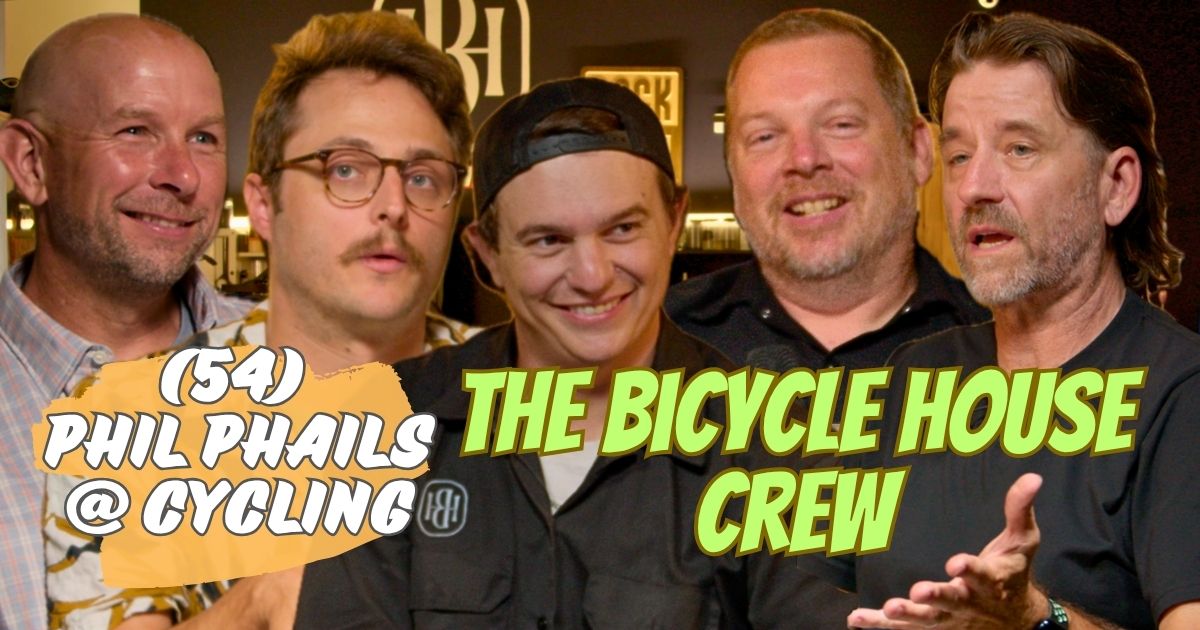
Cycling Community in Austin, How Group Rides Build Fitness, Friendship, and Resilience
What weekly group rides reveal about confidence, consistency, and finding your people