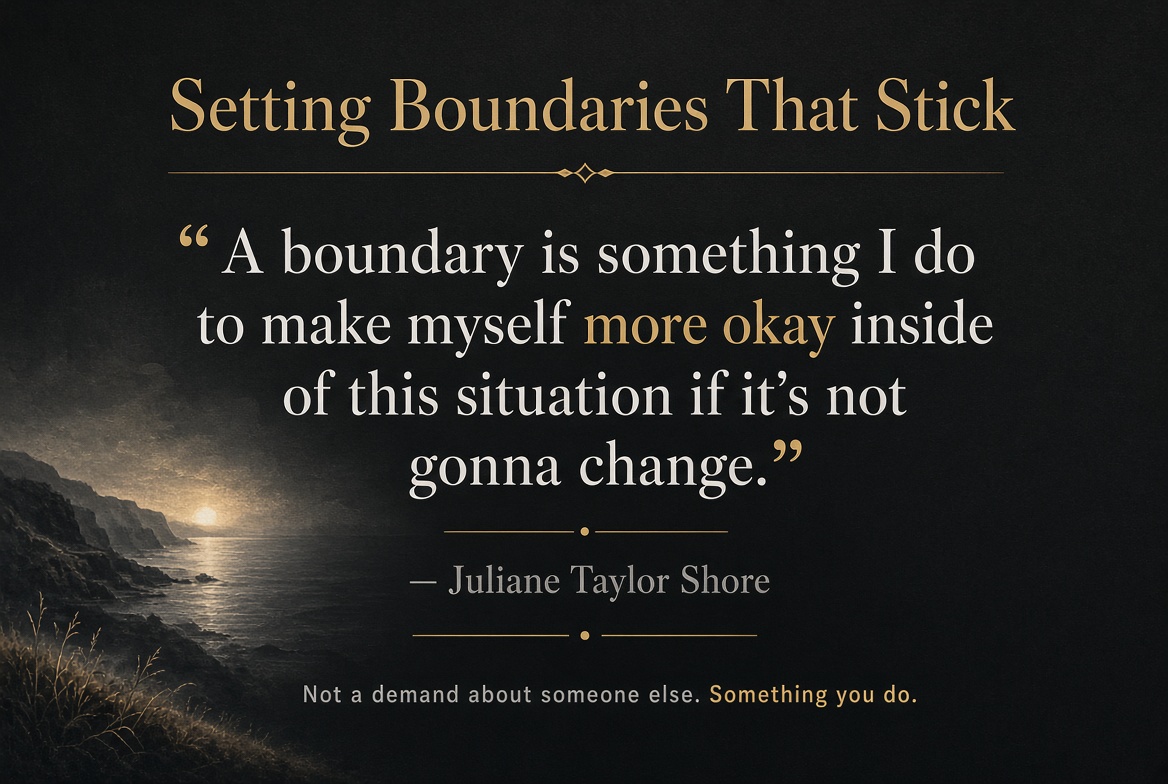
Most of us think of a boundary as a message we send to someone else: stop doing that, don’t talk to me that way, change. Juliane Taylor Shore starts somewhere different. In her words, “A boundary is something I do to make myself more okay inside of this situation if it’s not gonna change.”
In this conversation with Jules, a therapist, author, and educator, we explored how the brain holds our history and what that means for the way we set limits with the people in our lives. She builds the foundation first, with how old learning gets stored and whether it can be updated, and only then moves to the practical work of requests, boundaries, and follow-through.
It was a long, unhurried conversation, and Jules kept it grounded. At several points she was candid about where she was describing her own clinical experience rather than settled science, and she never promised a quick fix.
Starting With How We Show Up
We opened by comparing how each of us prepares for a conversation. Jules described preparation less as gathering information and more as grounding: “Did I get grounded for a second? Did I wonder what I have hope for inside this conversation? Did I treat myself kindly a little bit before I took a breath and said, OK, let’s go?”
She also spoke openly about her own experience of ADHD, autism, and dyslexia, including a metaphor for her thinking: “It’s like I’m living in the middle of a spherical spider web. And I can see all of the different thoughts. And I don’t know which one to tell you about first, because they’re all of equal importance.”
The Psychological Floor
Early on, Jules introduced a term she uses for the history we carry without noticing. “You do not take a step. You do not take a breath without history being part of it. This is your psychological floor.”
Her point is that this accumulated learning runs in the background, and it can feel as real as the ground under your feet. That is why a belief like “I don’t belong” doesn’t feel like a belief. It feels like reality.
Can Old Learning Be Updated?
From there she walked through what she calls memory reconsolidation, a kind of neuroplasticity in which an old emotional learning is brought up and then met with an experience that doesn’t fit it. “And the cool thing about memory is that it’s updatable. Not that you’re ever gonna forget what happened, but you could shift what you learned from what happened.”
She separated this from simply adding good experiences on top of old ones, using a layer-cake metaphor. She also told a personal story about working with her own belief that she didn’t belong. It is one person’s account, and she told it that way.
A Boundary Is Something You Do
The second half of the conversation turned practical. Jules separated a boundary from a demand and started with the direct request: asking for something while genuinely being okay with hearing “no.” As she put it, “a request is only really a request if we are okay with no.”
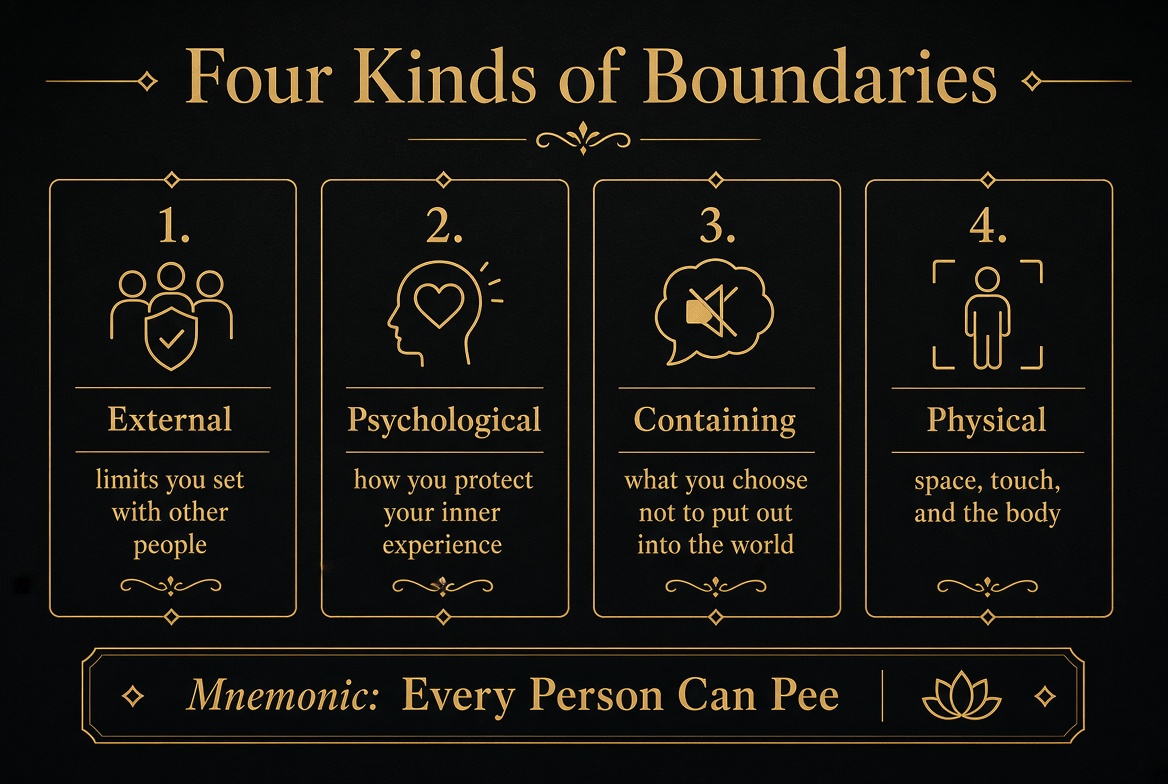
Along the way we talked about ask culture versus guess culture, the habit of complaining until someone changes and then demanding, and four kinds of boundaries: external, psychological, containing, and physical. Her mnemonic for remembering them is “Every Person Can Pee,” and it works.
Working With a Psychological Boundary
Jules also guided me through a psychological boundary using a real example from my own life, organized around a question she keeps returning to: Is it true? Is it about me? We used imagery for this, and she was clear that there is no wrong choice. “There is no such thing as the right boundary image. There’s only yours.”
The Pigeon and the Six Steps
For boundaries that involve another person, Jules offered a six-step approach that begins with defining a “big why.” She also gave a practical warning: expect pushback. She referenced Mo Willems’s picture book Don’t Let the Pigeon Drive the Bus! and said, “When setting a boundary, I want you to expect the other guy to be the pigeon.”
Grief, Love, and Awe
Near the end, Jules said something many of us need to hear: “There’s no such thing as setting a boundary and not having grief on the other side.” She was just as plain about what boundary work can’t do. “Healing is not a werewolf, y’all.” There is no silver bullet.
Her closing thread tied grief, love, and awe together: “Grief, love, and awe. It’s all just, how do you open up your capacity to face what’s here?”
Personal Reflection
Before we sat down, I tried something I don’t normally do: researching my guest. I quickly realized that isn’t how I work, and that I was trying to be something I’m not. Jules’s idea of preparation as grounding rather than information-gathering gave me language for what I had already sensed.
Later, working through a psychological boundary with her, I was reminded how different it is to understand an idea and to practice it. A concept can make sense and still leave the old reflex untouched.
Practical Takeaways
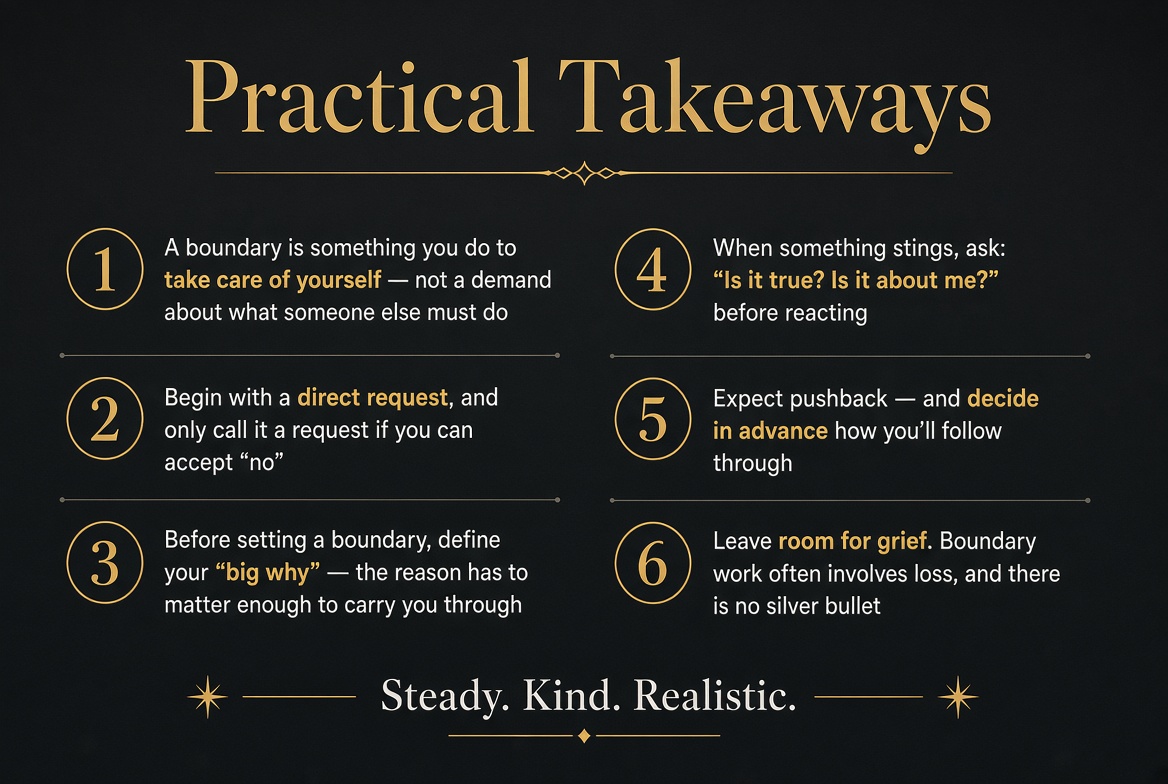
- Think of a boundary as something you do to take care of yourself, not a demand about what someone else must do.
- Begin with a direct request, and only call it a request if you can accept “no.”
- Before setting a boundary with someone, define your “big why.” Jules explained that setting a boundary and sticking to it is hard, so the reason has to matter enough to you to carry you through.
- When something stings, try the question “Is it true? Is it about me?” before reacting.
- Expect pushback when you set a boundary, and decide in advance how you’ll follow through.
- Leave room for grief. Boundary work often involves loss, and there is no silver bullet.
Conclusion
This conversation did not offer a technique to master in an afternoon. It offered a way of looking at how we got here, why a boundary can feel so charged, and what it takes to hold one with some steadiness and kindness. Jules was generous with her framework and honest about its limits. That combination is rare, and it made the long conversation worth having.
A Note on This Conversation
This was a conversation, not medical or mental health advice. Jules shares her professional perspective and personal experience, and some of the neuroscience is described in simplified form. Memory reconsolidation in particular is an active area of research, so please treat her explanations as one clinician’s framework rather than settled fact. For decisions about your own care, talk with a licensed professional.
Care note: Around 3:08:45 we discuss sexual assault and why boundaries can’t guarantee safety. If this brings up something difficult, support is available. In the U.S., you can call or text 988, or contact RAINN at 1-800-656-4673.
Guest Bio
Juliane Taylor Shore, also known as Jules, is a licensed professional counselor and licensed marriage and family therapist, author, educator, and mom who creates spaces where people can move into more self-compassion, self-trust, empowerment, and integrity. She regularly teaches and speaks to people from all around the world, and she translates new understandings in neurobiology into practices that can support brain change.
Jules came into the therapy world as a client who argued that feelings didn’t matter, only to find herself, all these years later, having followed neuroscience to the obvious conclusion: we are really feeling and meaning-making beings driven by our interdependence. She believes that embracing that reality is key to finding purpose and deep joy.
She is the author of Setting Boundaries that Stick: How Neurobiology Can Help You Rewire Your Brain to Feel Safe, Connected and Empowered, and the creator of The STAIR Method, a brain-based, integrated method of experiential therapy.
Find Juliane Taylor Shore
- 🌐 Website: julianetaylorshore.com
- 📘 Book: Setting Boundaries That Stick
- 🧠 Method: The STAIR Method
- 📸 Instagram: @JulianeTaylorShore
- 👥 Facebook: Juliane Taylor Shore
If This Resonated
These conversations explore similar themes.

ADHD in Groups: Hope, Rejection, and the Path to Agency
Navigating Group Exclusion with ADHD: A Personal Exploration

Why You Keep Repeating Relationship Patterns, Attachment Wounds and How Healing Actually Starts
Why We Keep Falling Into the Same Relationship Cycles