Most people who walk into a gym are chasing a visible result—less fat, more muscle, a different shape in the mirror. Nick Deacon started there too. What makes his path interesting is how far beyond the mirror the practice eventually reached.
In this conversation we explored bodybuilding not as a sport or a vanity project, but as a form of intentional culture-building: a regular confrontation with oneself, a discipline that can become spiritual, and a way of training the body to function as a more sensitive antenna for life.
The episode is framed as Phil Phails at Bodybuilding. The real subject turned out to be thoughtful, long-horizon physical culture.
The Gym as Church
Early in his training life, Nick noticed the gym becoming something more than a place to get stronger. Looking himself in the eyes in the mirror became a form of self-surveillance and self-encouragement. The part of him that wanted to stop met another part that said, keep going. Over time that internal dialogue took on a spiritual quality.
He describes the practice the way some people describe church: a repeated return to the same place, the same work, the same confrontation with limitation. The point was never only the physique. It was the repeated decision to continue under difficulty, and the slow cultivation of a relationship with one’s own body that felt honest rather than purely instrumental.
Three Hats, One Culture
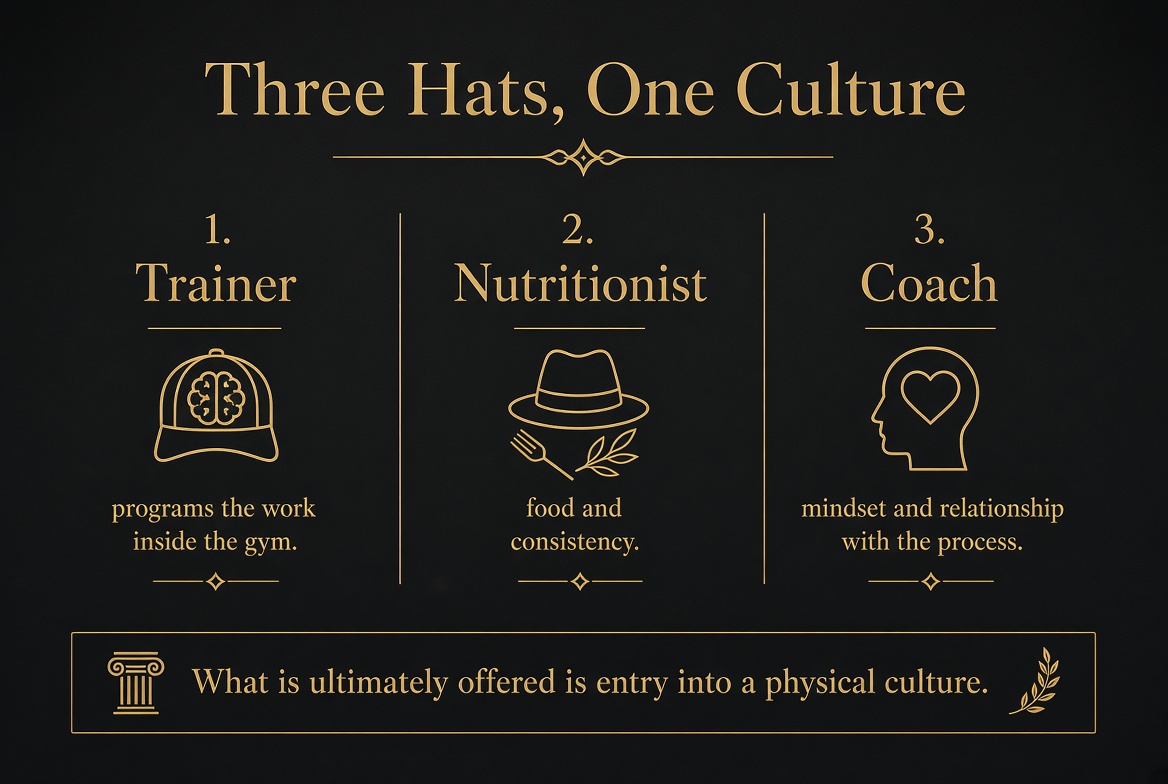
When people come to Nick wanting “the results you’re getting,” he wears several overlapping roles. There is the trainer who programs the work inside the gym. There is the nutritionist who deals with food and consistency. And there is the coach who helps someone develop a mindset and a relationship with the process that they do not constantly resist.
What he is ultimately offering is entry into a culture. Physical culture is not just a set of exercises. It is a set of values, habits, and ways of moving through the world that prioritize the body’s development and the meaning found in that development. Some people look at that culture from the outside and call it extreme. Others are drawn to it. Nick’s work is helping people find their own authentic place inside it.
The Body as Antenna
One of the more interesting turns in the conversation was Nick’s recognition of the costs of extreme specialization. At the height of focused bodybuilding, certain autonomic functions—things as basic as laughing freely, gasping in water, or moving with natural fluidity—became impaired. The body that had been shaped for a particular aesthetic or performance goal had also become less available as a sensor.
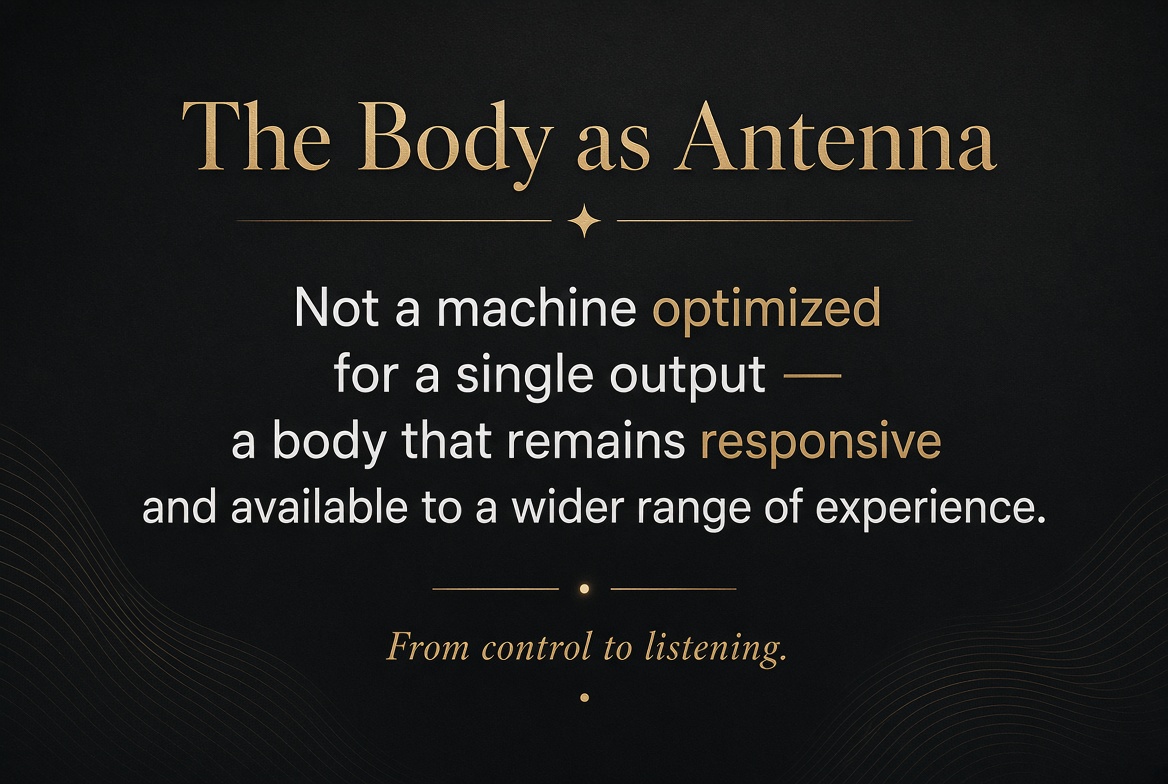
This led him toward a broader goal: not simply a stronger or leaner body, but a body that could support a richer, more colorful experience of life. He began treating physical practice as a way of keeping the organism malleable and responsive—an antenna rather than a machine optimized for a single output.
That shift connected him to practices that look, from the outside, far removed from traditional bodybuilding: authentic relating, greater attention to the nervous system, more play, more social and emotional range. The original desire to control the body and change its appearance became a doorway into something deeper.
Childhood Memory and the Long View
Nick was born in Auckland, New Zealand—Aotearoa, the land of the long white cloud. His early memories are filtered through a child’s sensory intensity: junk food with specific textures and names, the feeling of being small in a landscape that still felt magical. He left after about five years, but the lens of childhood memory remained.
Even as a young child he was already thinking about his eighty-year-old self. Decisions were made with that future person in mind. The awareness of aging, of the possibility of decline, and of the desire to arrive at old age with capacity rather than collapse, has been a quiet through-line. Bodybuilding, in this light, is less about the next twelve weeks and more about the next fifty years.
Watch the full Life Story conversation:
Personal Reflection
What stayed with me is the refusal to treat physical training as either purely aesthetic or purely functional. Nick holds both the practical reality of progressive training and the possibility that the same practice can become a form of self-knowledge and even spiritual discipline.
I recognized my own relationship to movement—cycling, climbing, the ways I use the body as a place of focus and reset. The invitation is not to adopt someone else’s exact methods, but to notice whether the relationship I already have with physical practice could be made more intentional, more honest, and more long-horizon.
Practical Takeaways
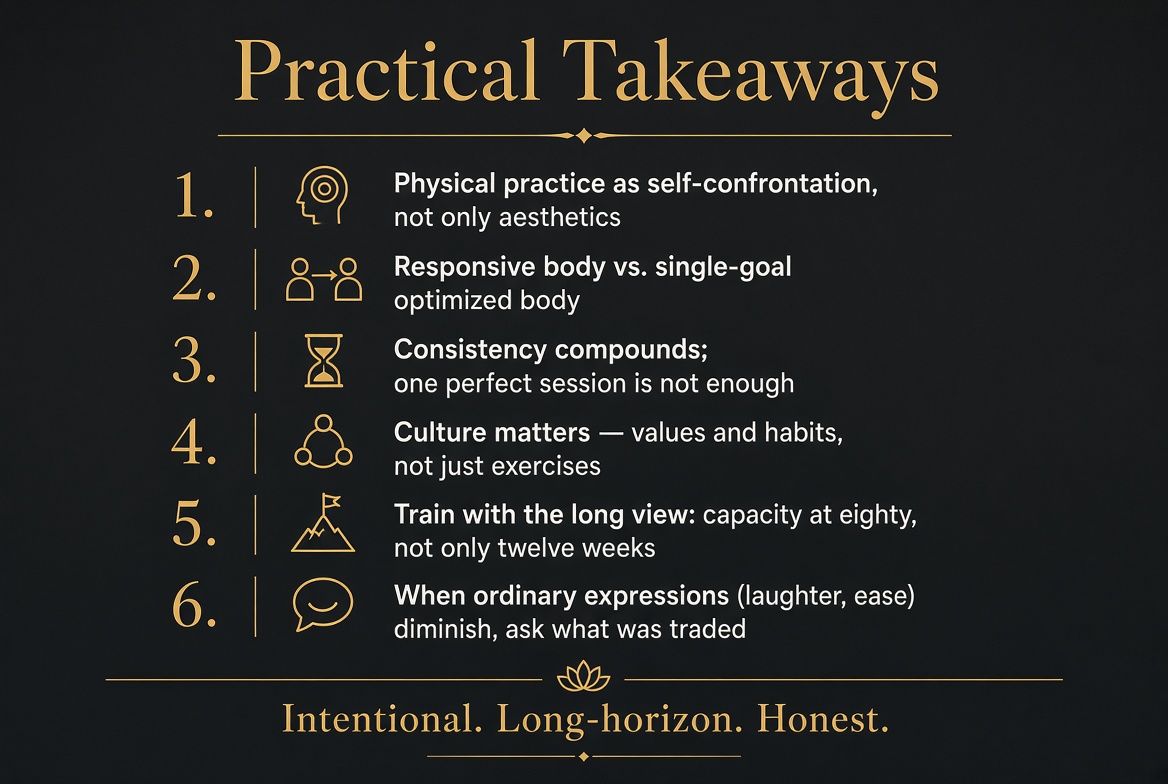
- Treat repeated physical practice as a form of self-confrontation and discipline, not only as a means to an aesthetic end.
- Notice the difference between a body optimized for a single goal and a body that remains responsive and available to a wider range of experience.
- Consistency compounds; a single perfect session means little without a sustainable relationship to the work.
- The culture around physical development matters. People are not only learning exercises; they are being invited into a set of values and habits.
- Early awareness of aging and long-term capacity can usefully shape present training choices.
- When the body becomes less available for ordinary human expressions—laughter, fluid movement, autonomic ease—it is worth asking what has been traded away.
Conclusion
Nick Deacon’s version of bodybuilding is not the loudest or the most extreme. It is quieter and more deliberate: a practice that began with the desire to change the body and gradually became a way of listening to it, refining it, and keeping it available for a fuller experience of being alive.
The conversation left the door open for continuation. That feels right. Some practices are not finished in a single sitting. They are lived, adjusted, and returned to over years.
This is Phil Phails at intentional and thoughtful bodybuilding.
Guest Bio
Nick Deacon is a health coach and physical culturist whose work centers on intentional bodybuilding and the broader culture of physical development. He helps people build sustainable relationships with training, nutrition, and mindset, treating the process as both practical discipline and a form of self-awareness. His approach emphasizes long-term capacity, nervous system health, and the possibility that physical practice can become a meaningful, even spiritual, part of a life.
If This Resonated
These conversations explore similar themes.
ADHD, Open Heart Surgery, and Mental Health Through Fitness: James Carr on Strength Training and Survival
How Lifting Weights Helped James Survive
SMART Fitness Goals, DEXA Scans, and Building Lasting Fitness Confidence
Turning fitness data into confidence and habits that actually stick