The practice begins on the mat, but the real work happens in daily life.
If you’ve spent any time in a yoga class, you’ve probably heard a Sanskrit word dropped into a sequence—ahimsa, pranayama, savasana—and nodded along without fully knowing what it meant. I did that for years. I came to yoga for the movement, stayed because it made me feel better, and never really asked the deeper question: what is this practice actually for?
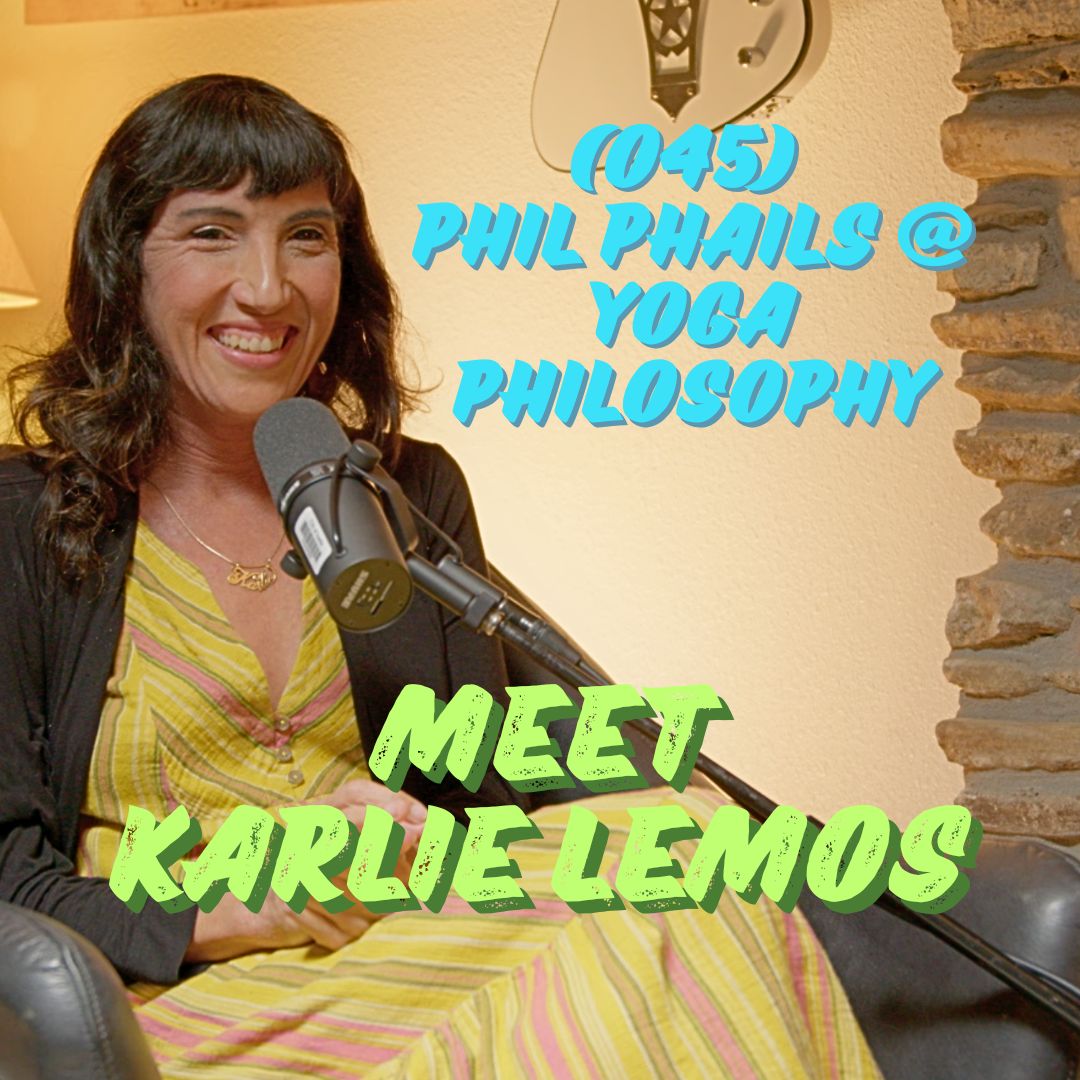
That’s what this conversation with Karlie Lemos is about. Karlie is a yoga teacher with over 26 years of practice and nearly two decades of teaching experience. She co-owns Studio Satya in Austin, Texas — a studio built around the idea that yoga is something more than fitness. When I sat down with her on Phil Phails, I wanted to understand the philosophy underneath the postures. What I got was a conversation that made me rethink what I thought I knew about yoga, the mind, and what it might mean to truly remember who you are.
What Yoga Actually Is (Hint: It’s Not the Stretching)
The first thing Karlie said that stopped me was this: the physical practice of yoga — the poses, the movement — is called asana. And asana is only one of eight limbs. It’s not yoga itself. Yoga, in the philosophical sense, is an experience. You can’t see it happen. It happens inside.
The most widely cited definition comes from the Yoga Sutras of Patanjali, an ancient text that functions something like a field guide to the practice. Sutra 1.2 defines yoga as chitta vritti nirodha — the cessation of the fluctuations of the mind. The stilling of that relentless internal chatter. The quieting of what many Eastern traditions call “monkey mind.”
Karlie put it another way that stayed with me: yoga is the state where nothing is missing.
That’s not the marketing language of a gym membership. It’s something closer to what contemplative traditions have always pointed toward — a quality of presence, of completeness, of not perpetually grasping for the next thing. It’s a practice of remembering, she said. Not achieving. Remembering.
The implication is that whatever yoga leads to is already inside us. The work is clearing away everything that obscures it.
The Eight Limbs of Yoga: A Map, Not a Checklist
Patanjali’s yoga sutras organize the path into eight limbs — a structured progression from ethical behavior outward to the deepest states of absorption within. Karlie walked me through all of them, and what struck me was how little any of it has to do with flexibility.
The Yamas are the first limb — the ethical guidelines for how we behave in community. They include ahimsa (non-harming), satya (truthfulness), asteya (non-stealing), brahmacharya (wise use of energy, including sexual energy), and aparigraha (non-grasping). These aren’t commandments backed by threat of punishment. They’re more like prerequisites — ways of behaving in the world that make the quieter inner practices possible. If you’re out there harming people or being fundamentally dishonest, you’ve created noise that the rest of the practice has to shout over.
The Niyamas are the second limb — the guidelines for how we relate to ourselves. Saucha is cleanliness. Santosha is contentment. Svadhyaya is self-study, which Karlie described as lifelong learning — cultivating the mind over time. And ishvara pranidhana is surrendering to something larger than yourself, whether you call that God, the universe, or a deep trust in the unfolding of things.
Asana comes third. Not first. Posture, the physical seat — the very thing most of us associate with the whole practice. In the original tradition, asana was primarily about preparing the body to sit still in meditation for extended periods. The thousands of poses we have now came much later.
Pranayama is the fourth limb — breath practices. Not just breathing consciously during a vinyasa flow, but specific, formal practices devoted entirely to working with the breath: alternate nostril breathing, kapalabhati, or what Karlie and I both know informally as “horse breath.” The breath, in this system, is a bridge between the body and the mind.
Pratyahara is the withdrawal of the senses — the deliberate turning inward, away from the flood of external information. This is the point in practice where you begin to untangle yourself from the constant pull of sights, sounds, and stimulation.
Dharana is concentration — one-pointed focus. The practice of bringing attention to a single object and returning to it when the mind wanders. This is where the deeper states become possible.
Dhyana is meditation itself — the sustained, uninterrupted flow of that concentrated attention. Not just sitting quietly, but the actual quality of absorbed awareness that consistent practice cultivates.
And finally, Samadhi — absorption. The state in which the separation between the one who is meditating and the object of meditation dissolves. Karlie described it as returning to the universal oneness of everything. She was honest: she doesn’t know anyone who has fully arrived there. But she’s had brief, luminous glimpses. Those moments where, for an instant, you understand something that words immediately fail to hold. And then it’s gone. So you practice again.
The Box Around You: Samskaras and the Work of Remembering
One of the most useful images from our conversation came from Karlie’s description of what practice is actually undoing. When we’re born, she said, we arrive free — unencumbered by the accumulated impressions that yoga calls samskaras. And then life begins. Family, school, culture, religion, trauma, expectation. These all begin to build what she called a box around us. We learn how to fit inside it, because that’s what survival requires.
Yoga practice, in this frame, is a slow process of dismantling that box. Not destroying who we’ve become, but taking pieces off — loosening the edges — so that we can express more freely. So that we can remember who we were before the world told us who to be.
I think about this in my own life. The things I was told, explicitly or not, to keep quiet. The versions of myself that got too loud, too much, too something — and got turned down. A lot of the work I’ve done over the past few years, whether through therapy, improv, conversations like this one, has been some version of pushing against those walls. Seeing which ones were real and which were only believed.
Yoga, it turns out, has been doing that same work for thousands of years.
How Practice Changes You: The Evidence Is in the Body and the Mind
I asked Karlie the honest question: after 26 years of practice, what can she actually point to? What has changed?
Her first example made me laugh: she doesn’t scream obscenities at people in traffic anymore. A long honk here and there, she admitted, but the rolled-down-window, F-bomb days are behind her.
But beneath the humor is something real. She described patience as one of the most tangible benefits — a capacity for equanimity that has grown slowly, year over year, through the practice. And then she was equally honest about the setbacks. When her daughter was born in 2020, it felt like all the growth she had accumulated got swept off the shelf. She found herself back at the beginning — reactive, overwhelmed, responding the way her own parents had responded. Which is part of why she calls practice a practice of beginning again. Not because you lose the ground you’ve covered, but because life keeps presenting new territory to cross.
Children, she said, are teachers. Relentless ones.
This resonated with me. I’ve had my own version of that experience — moments where I was certain I’d grown past something, and then found myself right back in the middle of it, usually at the worst possible moment. Growth isn’t linear. The eight limbs aren’t a staircase you climb once. They’re more like a practice you return to, again and again, with whatever you’ve learned.
Yoga Is a Living Tradition: What Gets Lost in Translation
One thing Karlie was careful to hold throughout the conversation was the awareness that we’re borrowing something. Yoga emerged from a context — ancient India, a completely different relationship to time, to society, to the body — that is not our context. The texts were written for people who had renounced household life to devote themselves entirely to practice. They weren’t navigating deadlines and parenting and Austin traffic.
That doesn’t mean the tradition has nothing to offer us. It means we have to approach it with humility. The sutras were written without commentary because the ideas were so dense they couldn’t stand alone — each translation includes explanation, because we’re so far from the world in which they were composed.
What Karlie and her co-owners are trying to do at Studio Satya — and what drew me to the studio in the first place — is honor the roots of the practice while meeting people where they are. Not every class needs to be a philosophy seminar. But none of them should pretend that yoga is only about the shape your body makes.
When I asked her what makes the studio unique, she came back to that word: cessation. The stilling of the fluctuations. That’s what they’re working toward. Everything else is in service of that.
My Reflection: What I Didn’t Expect to Find
I came into this conversation expecting to learn some vocabulary. To finally understand what all those Sanskrit words mean when the teacher says them. And I did get that. But I didn’t expect to walk away with a felt sense of what yoga has been pointing toward all along.
I’ve been going to Studio Satya for a while now. I noticed early on that I felt different after class — not just looser in the body, but quieter in the mind. I could dismiss that as endorphins, as the simple benefit of movement. But what Karlie described is something more specific: a practice designed, over thousands of years, to gradually interrupt the noise. To help you get out of your own way.
The thing that stayed with me most was that word remembering. The idea that what we’re working toward isn’t something we have to construct or achieve. It’s something we’re trying to uncover. Something already there, under all the boxes the world has built around us.
I don’t know if I believe I can get there. But I’m curious enough to keep going back to the mat and finding out.
Practical Takeaways
-
Start with the Yamas as a daily practice. Non-harming, truthfulness, non-grasping — these aren’t abstract. They show up in every conversation, every reaction, every small choice. Noticing where you violate them is itself a practice.
-
Don’t wait until you understand yoga to do yoga. Karlie found the stillness the first time she practiced. The philosophy came decades later. The experience is the teacher.
-
Curiosity is the metric of success. Karlie’s definition of progressing in yoga philosophy wasn’t mastery — it was staying curious. If you think you know, you’ve stopped.
-
The physical practice is not yoga — but it can lead there. Asana is a doorway. Whatever gets you through the door is fine. But notice if something quieter is starting to happen once you’re inside.
-
Treat practice as remembering, not improving. This reframe matters. Self-improvement can become another way of being at war with who you are. Remembering is gentler. It assumes that what you’re looking for is already present.
-
Consistency matters more than intensity. The eight limbs aren’t a summit you climb. They’re a rhythm you return to. Small, consistent practice changes things that sporadic intensity cannot.
-
Let the practice find you. Karlie didn’t plan to become a yoga teacher. She stumbled into a class because she didn’t know how to be still. The tradition has a way of arriving right on time.
Conclusion
There’s a line from Patanjali that Karlie quoted early in our conversation, and I’ve been sitting with it since. The Yoga Sutras say that when the fluctuations of the mind cease, the seer will be established in their own true nature. When the noise settles, you’ll see yourself.
That’s a remarkable claim. And an uncomfortable one, because it implies that most of the time we don’t. That we’re seeing through all the accumulated impressions and conditioning and boxes and stories — and calling that us.
I don’t think a yoga class solves this. I don’t think anything solves it quickly. But I do think there’s something worth paying attention to in a tradition that has been asking this particular question — who are you, really? — for thousands of years. Not as a philosophical puzzle, but as a daily practice. Something you return to on the mat, in the breath, in the pause before you react.
The box is real. And it’s also not who you are.
About Karlie Lemos
Karlie Lemos has been practicing yoga since 1998 and teaching since 2006. Trained in Iyengar, Anusara, Restorative, and Ashtanga yoga, her teaching is grounded in the philosophical foundations of the tradition — intelligent sequencing, mindful movement, and the subtle art of listening to the body, breath, and inner wisdom.
In 2021, Karlie became a co-owner of Studio Satya in Austin, Texas, alongside Hollie and Mary. The studio offers a wide range of classes — from vinyasa and yin to prenatal, kids, and therapeutic yoga — rooted in a shared commitment to inclusivity, community, and the roots of the practice.
- Instagram: @studio_satya_austin
- Facebook: Studio Satya Austin
- Website: studiosatya.com
If This Resonated
These conversations explore similar themes.

Building a Real Yoga Community in Austin, Inside Studio Satya’s Story of Connection and Practice
How Studio Satya became a space where yoga turns into real community and connection

Finding Balance Through Yoga, Breath, and Nervous System Regulation
How yoga helps you stay grounded through stress, change, and emotional swings