This is not a story about one man being right and another being wrong.
It is a story about what happens when a group that names accountability, safety, and brotherhood is asked to live those values under pressure.
I joined an I-Group connected to the Mankind Project in the summer of 2025. I came looking for connection, challenge, and a place to do my work among other men. For a time I found pieces of that. I also found something else: a gap between the language of the container and the way power, anger, and repair actually moved through it.
What follows is the full sequence of documents I wrote, the responses I received, the research and frameworks I studied, and the questions that kept surfacing. I share them so a reader can walk the same ground I walked—seeing the primary materials, the group’s replies, the cognitive patterns that shape these situations, and the larger dynamics that often appear in men’s work.
Names of every man except Craig and myself have been removed to protect anonymity.

The Incident (October 20)
I was serving as King that night. During a discussion on member engagement I asked that both Craig and I remain quiet so other voices could be heard. Later, during the Charges portion of the meeting, Craig stated he had a charge with me. I chose not to stand in the place of his mirror. I sat down and followed the facilitator, treating the moment as an opportunity to learn the process.
While reading from the PIT manual I heard an abrupt, loud, aggressive expletive shouted by Craig: “Fuck!” The outburst was unexpected and startling. It triggered fear and a strong emotional response. My sense of safety in relation to Craig shifted in that moment.
Craig then questioned my leadership as King, said he did not feel safe to do his work, and presented an ultimatum: either I leave or he would. After that he told me several times, while standing and with a raised voice, to “shut your fucking mouth.”
Our written I-Group agreement includes the line:
“Any man may pass on participation in any role, process, or part of a meeting without retribution.”
I believed I had chosen to pass on the clearing process and then experienced retribution for doing so.
The Mankind Project USA Ethics Policy states:
Standard 6 – Respect
“Because I commit to treat others (including MKP USA as an institution and its leaders) with compassion, generosity, and respect, I will not engage in bullying, harassment, or similar abusive behavior… I recognize that such behavior can be a single act or a pattern of seemingly minor behavior that persists after I become aware of its harmful impact.”
Standard 5 – Safety
“I will not engage in or threaten intentional direct physical, mental, emotional, or spiritual harm to a person.”
I experienced Craig’s words and tone as inconsistent with both standards. The fact that he held a respected role as an Elder and carried significant organizational influence within the circle made the impact heavier.
The Letter I Sent to the Group
I wrote the following letter the next day and shared it with the circle.
Subject: Reflection on Our Last I-Group Meeting
Dear Brothers,
I want to share my experience from our meeting last night, offered in the spirit of integrity, accountability, and shared awareness.
During the meeting, while serving as King, I experienced a challenging interaction with Craig. At one point in our discussion on member engagement, I asked if both Craig and I could remain quiet to allow other voices to be heard. When Craig continued speaking, I repeated my request.
Later, during the Charges portion of the meeting, Craig stated that he had a charge with me. I chose not to stand in the place of his mirror and instead sat down, following along with the facilitator, using the moment as an opportunity to learn and better understand the clearing process. While reading from the PIT manual, I heard an abrupt, loud, and aggressive expletive shouted by Craig — “F***!” This outburst was unexpected, startling, and triggered a wave of fear and strong emotions. It was unexpected because it was surrounded by what I interpreted as sadness. This impacted my sense of safety in relation to Craig, which later played a role in my decision not to engage in a clearing session with him when I expressed a charge was present.
Following that, Craig stated that he questioned my leadership as King, that he did not feel safe to do his work, and presented an ultimatum that either I leave or he would. After this Craig told me several times to “shut your f***ing mouth,” with a raised voice and in what I experienced as an aggressive tone while also standing up.
Our written I-Group agreement includes the statement:
“Any man may pass on participation in any role, process, or part of a meeting without retribution.”I believe I chose to pass on the clearing process and then experienced retribution for doing so.
The Mankind Project USA Ethics Policy also includes:
Standard 6: Respect – “Because I commit to treat others (including MKP USA as an institution and its leaders) with compassion, generosity, and respect, I will not engage in bullying, harassment, or similar abusive behavior… I recognize that such behavior can be a single act or a pattern of seemingly minor behavior that persists after I become aware of its harmful impact.”I experienced Craig’s words and tone as inconsistent with this standard. When anger is expressed toward another man with profanity, volume, and aggression, I believe it can cause harm and disrupt the safety of the circle.
Standard 5: Safety – “I will not engage in or threaten intentional direct physical, mental, emotional, or spiritual harm to a person.”
I am especially concerned because Craig holds a respected role as an Elder within the Mankind Project community. He has attended many meetings and trainings, and he carries significant organizational power and influence within our circle. This dynamic made his words and actions all the more impactful, threatening, and difficult to experience.
Additionally, I have concerns about how anger and aggression are sometimes expressed in our group. When we act out anger physically or verbally as a way to “release” it, I worry that we reinforce rather than transform that energy. What we repeatedly practice becomes our pattern.
There were five of us present last night, and I believe it’s important that the entire group be aware of what happened. I share this not to blame or shame anyone, but to invite reflection on how we can better uphold the values of safety, respect, and compassion that define our I-Group and the Mankind Project as a whole.
With respect and sincerity,
Phillip Jones
I also attached an earlier email I had sent Craig on August 25 about working with anger. In that email I offered three perspectives:
- Science: Neuroscience shows that “what fires together, wires together.” Research by Brad Bushman and others suggests that venting anger physically tends to escalate it rather than release it.
- Mindfulness: Thích Nhất Hạnh compared anger to a crying baby—something to be held gently, not punished or forced out.
- Creativity: Julia Cameron, in The Artist’s Way, teaches that anger is valuable information and a map showing where boundaries have been crossed or needs unmet.
My hope was that we might model ways of listening to anger rather than acting it out aggressively.
The Responses
Several men responded in the group thread.
Man 1:
I have read the document.
Phillip thank you for sharing your data, judgements, and impacts from your interaction with Craig.
I judge this is a sensitive topic and I want to remind the men in this group that this is an opportunity to practice respectful communication and owning our experiences.
I assume that Craig also had an experience last night. Craig, since Phillip has shared his experience I invite you to do the same.
Phillip, since you took impacts from last night’s meeting I encourage you to check in with a brother, and I’m happy to be that brother.
To any men that want to check in with me, I will make myself available tomorrow between 1400-1700.
Man 2:
Read it! First thought is, DAMN, I wish I was there. Second thought, this is document is a gift and it really articulates why I think Phillip is such a great addition to the group!
Man 3:
I dont love this format for what was a charged and nuanced interaction but since it is now a group discussion (and I was there last night) I will chime in.
My perspective of the event with mostly data:
Two men had a disagreement
Craig stated he had a charge. Phillip passed to stand in
Craig was open and intentional that the charge was his projection and some anger was expressed within the process (not directed at Phillip). Multiple men (including myself) thanked Craig for his work. I was personally very moved by it.
Phillip stated that he had a charge and took back that statement
Craig then stated he had another charge
Craig did share heated words at this point and stated that he did not feel comfortable staying with Phillips leadership as king
Meeting end
I dont agree that you were punished for passing Phillip jones. While anger was expressed, my judgement is that no one was in any danger.
I believe that a lot of what you are feeling @Phillip jones is your own work/projections. I feel some sadness that you didnt feel comfortable sharing and touching some of this last night
Man 4:
I also don’t like this message format for this kind of thing. Overall I agree with Wade’s assessment.
The power of a mpk men’s group and the warrior round is working through conflict as it arises. Looking a man in the eyes and facing your fears, anger, sadness. It can be hard, even terrifying. I saw that Craig did that. That meeting then went off the rails unlike anything I’ve seen in my 10+ years of doing men’s work. It makes me very sad and, at the moment, reluctant to want to return to the group, to be honest. This will need some work with the whole group to repair.
Man 5:
I’ve taken some time to reflect as my initial reaction would have been coming from anger at the choice to draft a document in a group chat, and how that document characterized the events of a very charged and nuanced evening.
I will echo the sentiment that a group chat format is unconstructive.
MKP has frameworks and those frameworks are very important for processing challenging moments. By choosing to adjudicate Monday night’s meeting in a chat group I see that as circumventing (manipulating) the very well established processes laid out in these frameworks.
This implicitly sets a dangerous precedent in my opinion; the precedent being “if you don’t like the way the group went you send a group chat and process it over text message.” This is not my understanding of how MKP works because there is no accountability there.
I judge that there has been a significant rupture in our group and thus a significant repair is required. To put it in MKP language there are multiple charges that need to be processed.
It is also my belief that when a rupture happens together in a group, the healing must happen together in a group.
I also see us all as choosing to do something pretty difficult; this being choosing to come together as a group, often vulnerably, and visiting sensitive topics regularly while maintaining group cohesion. In my view this is a constant process of rupture and repair.
My want is for us to formulate our next steps around a shared understanding of the answer to this question:
What is needed to repair the rupture created in Monday night’s meeting, and what MKP frameworks, processes, and procedures will we need to turn to in order to achieve this goal of repair?
Here are some elements of my answer to this question.
- It must be done together, in person, and with significant attendance
- It must follow MKP standards and center around personal accountability
- It must be in pursuit of an end state where all the men in the group feel safe, supported, valued, and confident that the group will meet their need for deep personal work
Man 6:
I’ve gone over the responses and given thought about what I know from data available. My first reaction the the email was disbelief, betrayed trust, and anger. I found the manner which this unfolded unacceptable for any I-group. The one person we haven’t heard from is Craig. I’m more concerned about him. What happened belonged in the circle and should have stayed in the warrior round and been worked out and cleared. I wasn’t there. I’m sorry I wasn’t. Of all the responses, I’m grateful for Wade’s assessment and Ryan’s thoughtful sharing. If there’s one thing I’ve always admired about MKP is it’s embraces elders, their vision, wisdom, and puts complete trust in the process. Repairing this container will take time.
Craig did not respond in the thread.
Owning My Experience and Sensitivities
I wrote a longer reflection trying to hold two commitments at once:
- To own my experience, including my history, sensitivities, and nervous-system responses.
- To remain attentive to group process, power dynamics, and structural factors that shape safety and accountability.
I am highly sensitive to men expressing anger and aggression, especially when it is directed at me. On a scale of 1–10 I place myself around an 8 or 9. When that energy appears, my nervous system activates quickly. That activation is mine to own. At the same time, owning my trauma history does not require me to dismiss present-moment signals about safety, containment, and the use of power.
I named an epistemic risk: the possibility that my concerns would be received primarily as evidence of unresolved shadow, personal sensitivity, or an attempt to control the group, rather than as good-faith signals pointing toward questions of safety and integrity that belong to the group as much as to me.
I also made two specific requests of the group:
Request 1 – Clear Context for Anger and Aggression
I asked whether the group could agree to expressing strong anger or aggressive energy only within clearly defined containers (for example, Magician rounds or carpet work), with clear verbal signposting so men who need to prepare themselves or step out could do so.
Request 2 – Greater Structure Around the Safety Process
I asked that when anyone says “Safety,” all talking immediately stop and the room shift into silence until the King or designated holder resumes facilitation.
Cognitive Biases and Distortions
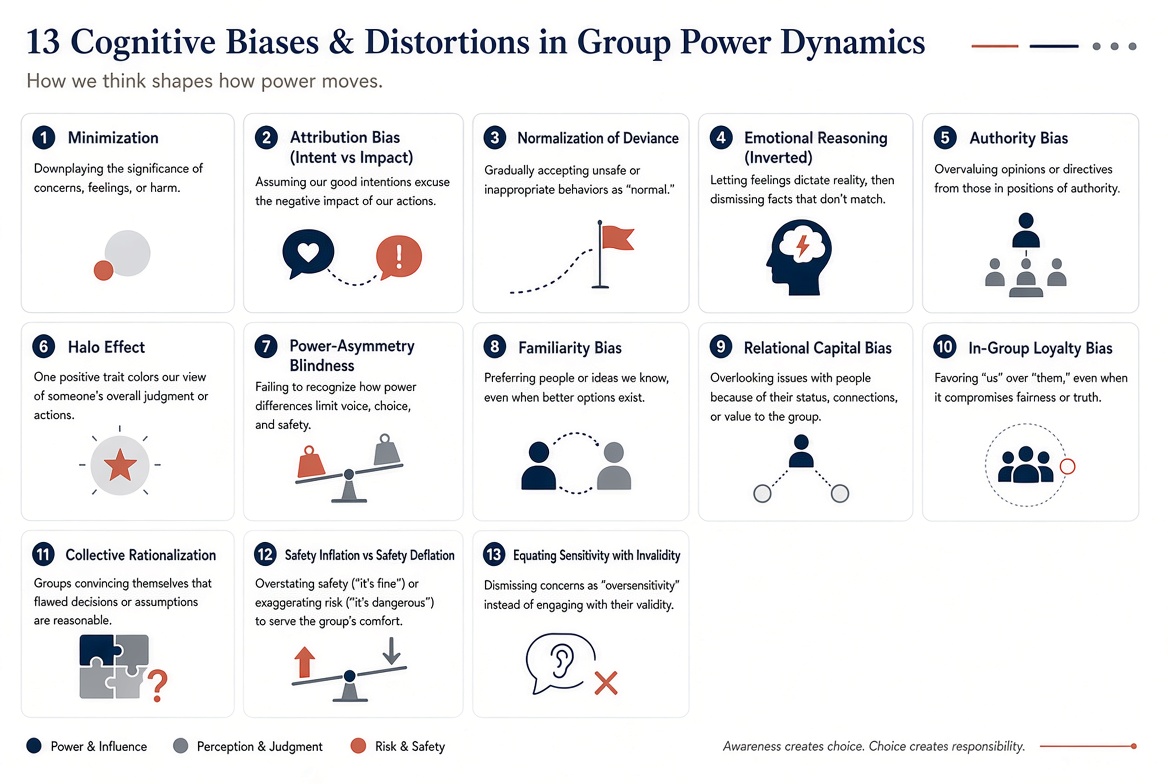
Any honest assessment of group safety requires attention to power. Power exists whether or not it is named, and it shapes perception, interpretation, and response. The following cognitive biases and distortions become especially relevant in contexts involving hierarchy, intimacy, and shared identity.
Core Cognitive Distortions (Individual-Level)
-
Minimization
“It wasn’t that bad.” “You’re overreacting.”
Common when someone identifies with the person holding power. Legitimate fear or harm gets downplayed rather than examined. -
Attribution Bias (Intent vs. Impact Gap)
People over-weight intent (“He didn’t mean it that way”) and under-weight impact (“But it landed as threatening”).
Key distortion: assuming good intent negates harmful impact. -
Normalization of Deviance
Behavior that should trigger concern becomes normalized because it happens gradually or is performed by respected members.
“That’s just how he is.” “That’s how the work gets intense.” -
Emotional Reasoning (Inverted)
“I don’t feel unsafe, therefore it wasn’t unsafe.”
This ignores that nervous systems differ, especially across trauma history, status, and role.
Biases Related to Power & Hierarchy
-
Authority Bias
People give disproportionate credibility and leniency to those with status, seniority, or founding roles.
Aggression from leaders is reframed as teaching, tough love, initiation, or necessary containment. -
Halo Effect
Positive traits (wisdom, leadership, service history) “spill over” and shield someone from scrutiny.
“He’s done so much good for the group—he wouldn’t cross a line.” -
Power-Asymmetry Blindness
People underestimate how power differentials affect perception. Those with more power often experience expression as release or clarity; those with less power experience the same behavior as threat, coercion, or loss of choice.
Biases Related to Relational History & Intimacy
-
Familiarity Bias
The longer someone has known a person, the more they discount harm.
“I’ve known him for years—he wouldn’t do that.” -
Relational Capital Bias
When someone has “earned credit” in the group, others unconsciously let them overdraft.
“He’s built enough trust—this must be an exception.” -
In-Group Loyalty Bias
Groups protect themselves by protecting key members.
“If we admit this was harmful, what does that say about us?”
Group-Level Distortions
-
Collective Rationalization
Multiple people unconsciously co-construct a story that reduces discomfort, avoids conflict, and maintains cohesion. Dissenting perceptions then feel “disruptive” rather than informative. -
Safety Inflation vs. Safety Deflation
Groups often define safety based on absence of physical violence and shared intention rather than nervous-system impact, power dynamics, and psychological threat. This leads to safety deflation for those who are more sensitive or less powerful.
One Meta-Distortion Worth Naming Explicitly
- Equating Sensitivity with Invalidity
“If you’re more sensitive, your perception is less accurate.”
In reality, sensitivity often increases detection, not distortion—especially around aggression, threat, and boundary violation. High sensitivity ≠ unreliability. It often means lower tolerance for ambiguity around danger.
What Others Have Reported
Across forums, blogs, and discussions (including Reddit, personal essays, and older critiques), recurring themes appear in reports about men’s groups connected to the Mankind Project and similar organizations:
-
Aggression framed as “process”
Intense anger or confrontational behavior is justified as shadow work or authentic expression, and is sometimes experienced by others as intimidating, dysregulating, or unsafe. -
Lack of accountability for senior members
Long-time or high-status men are given more leeway and are less likely to be challenged. Newer members feel pressure to adapt or tolerate. -
Rupture without repair
Conflicts happen (which is normal), but there is often no clear apology, no facilitated repair, and no structured follow-through. This is one of the most common complaints. -
Group cohesion over individual experience
Groups sometimes prioritize harmony, continuity, and loyalty over addressing harm directly. This can feel like: “My experience is being minimized so the group can stay intact.” -
Scapegoating dynamics
One man becomes “the problem” or “blocking the group,” especially when he raises concerns, challenges behavior, or pushes for accountability. -
Blurring of roles
Senior men offering coaching, mentorship, or “support” outside the group can create power imbalance, potential conflict of interest, and influence over perception.
There are also many men who report deeply positive, life-changing experiences. The reality is that the organization is inconsistent—the experience depends heavily on the specific group and leadership culture.
Group Dynamics Models
Several frameworks help name what can happen under stress:
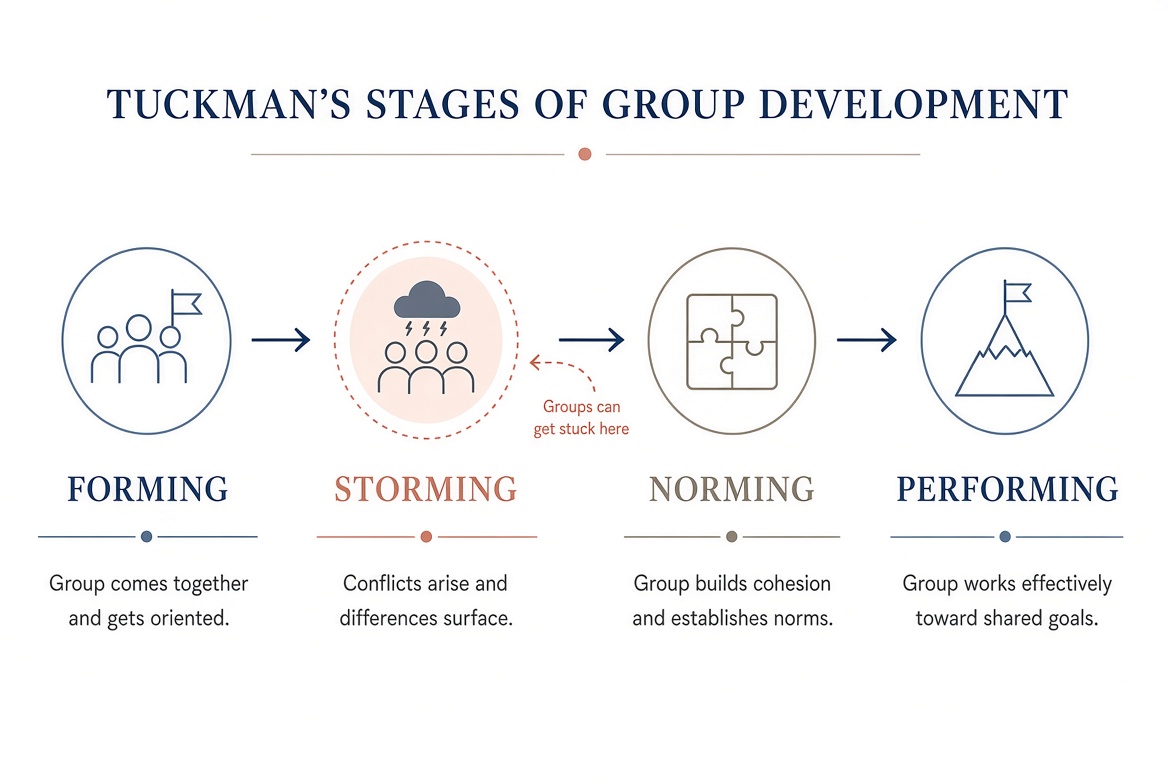
1. Tuckman’s Stages of Group Development
Forming → Storming → Norming → Performing.
Many groups get stuck in the Storming stage—conflict around values, power struggles, emotional reactivity, and lack of shared agreement on process. Getting stuck there often signals a leadership and structure failure.
2. Social Dominance Theory
Groups naturally form hierarchies even when they claim not to. Behavior from high-status individuals is minimized or protected; lower-status members or challengers face resistance.
3. Groupthink
Symptoms include suppressing dissent, maintaining cohesion over truth, rationalizing problematic behavior, and social pressure to conform.
4. Scapegoat Theory
Groups under stress often project tension onto one individual and unconsciously assign them as “the problem.”
5. Projection
Individuals and groups project disowned traits and uncomfortable truths onto others. Avoidance of accountability can be projected onto the person raising the issue.
6. Conflict Avoidance
Instead of addressing the behavior, groups shift to managing discomfort and maintaining relationships.
7. Power-Dependence Theory
Power comes from influence, relationships, and perceived value. Systems tend to preserve the person with more embedded power.
8. Cognitive Dissonance
When a group believes “We are safe” and “We uphold values” but behavior contradicts those claims, the dissonance is often resolved by reframing the person who names the contradiction as the problem.
None of this requires bad people or malicious intent. It only requires a group under pressure without sufficiently strong accountability structures.
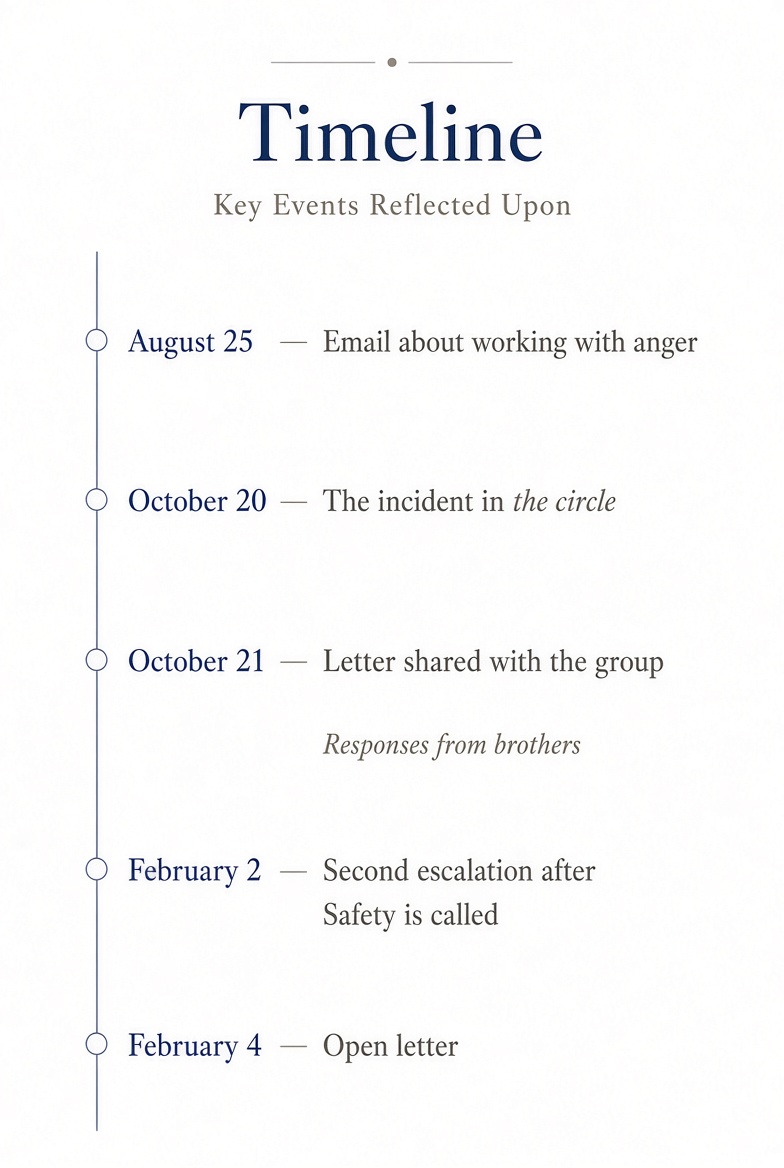
Timeline of Events
Later Reflections and the February Letter
By early February I had continued attending. A subsequent meeting escalated after “Safety” was called. The energy intensified rather than de-escalated. I experienced another moment of aggressive tone directed toward me and noticed myself entering a fawn response—seeking acceptance and inclusion rather than advocating for my own safety.
I wrote an open letter on February 4. In it I named three things I had hoped for after October 20 and had not received:
- A clear acknowledgment that threatening or aggressive communication toward another member is not acceptable in the group.
- A personal apology from Craig.
- An invitation into a repair process.
I asked whether the group was choosing relational loyalty or hierarchy over group safety. I used a simple thought experiment: if this group were a romantic relationship, how would I evaluate its health? The red flags were not only in the incidents themselves but in how they were addressed—or not addressed.
I made clear that I was not “running off.” I welcomed dialogue and the possibility of helping shape a culture that prioritized emotional regulation, de-escalation, accountability, and safety. I also stated that I choose to be intentional about the spaces and influences in my life.
What I Proposed
I drafted a set of proposed additions to group agreements focused on:
-
Behavioral Safety Standard
Aggressive, threatening, or demeaning communication—including yelling, profanity directed at another member, intimidation, or aggressive posturing—is not acceptable, regardless of intent, emotional state, or seniority. -
Equal Accountability
All members, including founders, facilitators, and senior members, are held to the same behavioral standards and accountability processes. -
Safety & De-escalation Protocol
When “Safety” is called: one designated facilitator speaks at a time; group volume and pace are intentionally reduced; discussion pauses if regulation cannot be restored. -
Mandatory Repair After Relational Harm
When a member’s behavior causes another member to feel unsafe, threatened, or harmed, a repair process is required if requested by the impacted member. Repair includes acknowledgment of impact, personal accountability without justification or minimization, and opportunity for facilitated dialogue. -
Trauma-Informed Awareness
The group recognizes that raised voices, aggressive tone, and intense emotional expression can activate trauma responses in others. Members commit to prioritizing nervous-system safety and self-regulation over emotional discharge. -
Right to Raise Concerns Without Retaliation
Members may raise concerns about safety, behavior, or group process without fear of retaliation, shaming, marginalization, or loss of belonging.
The proposal was offered as structure in service of trust and depth, not as punishment.
What This Leaves Me With
I still believe in the possibility of men’s work that can hold intensity without sacrificing safety. I still believe accountability that flows in all directions—including upward—is a form of love. I still believe repair is a sign of strength.
I also believe that when a container repeatedly fails to protect the conditions it claims to value, a man has the right—and sometimes the responsibility—to step back and choose environments that align with the person he is trying to become.
The gold, if there is any, is not in winning an argument or reforming a group. It is in the willingness to stay with the discomfort long enough to see both my own patterns and the patterns of the system, and then to act from that clearer seeing.
That is the work I am still doing.


If This Resonated
These conversations explore similar themes.
Safety, Anger, and Power in Men’s Groups: A Hard Look at the Mankind Project
There are spaces that claim to help men grow. They invite vulnerability, shadow work, and honest confrontation. Sometimes those same spaces reproduce the ver...
ADHD in Groups: Hope, Rejection, and the Path to Agency
Navigating Group Exclusion with ADHD: A Personal Exploration