There’s a story that opens Christian B. Miller’s The Character Gap that sticks with you. A man named Walter Vance collapses in a store during a Black Friday sale. Shoppers step over him—some without even noticing—on their way to discounted TVs and appliances.
Most people who hear the story immediately place themselves on the right side of it. “I would have stopped.” “Those people were selfish.” The third possibility is harder to sit with: I might not have stopped either.
That tension—the distance between the person we believe ourselves to be and the person who shows up when the situation gets messy—is what Miller calls the character gap. In this episode of Phil Phails Philosophy Book Club, Grant Potts and I sat down with Part One of the book to examine what character actually is, why it matters, and why the research suggests most of us live squarely in the middle of that gap.
What Character Actually Means
Miller is a philosopher at Wake Forest University whose work sits at the intersection of virtue ethics and moral psychology. He draws heavily on hundreds of psychological studies that test honesty, helping, compassion, and other traits under controlled conditions. The consistent finding is uncomfortable: the majority of people are neither consistently virtuous nor consistently vicious. We are mixed.
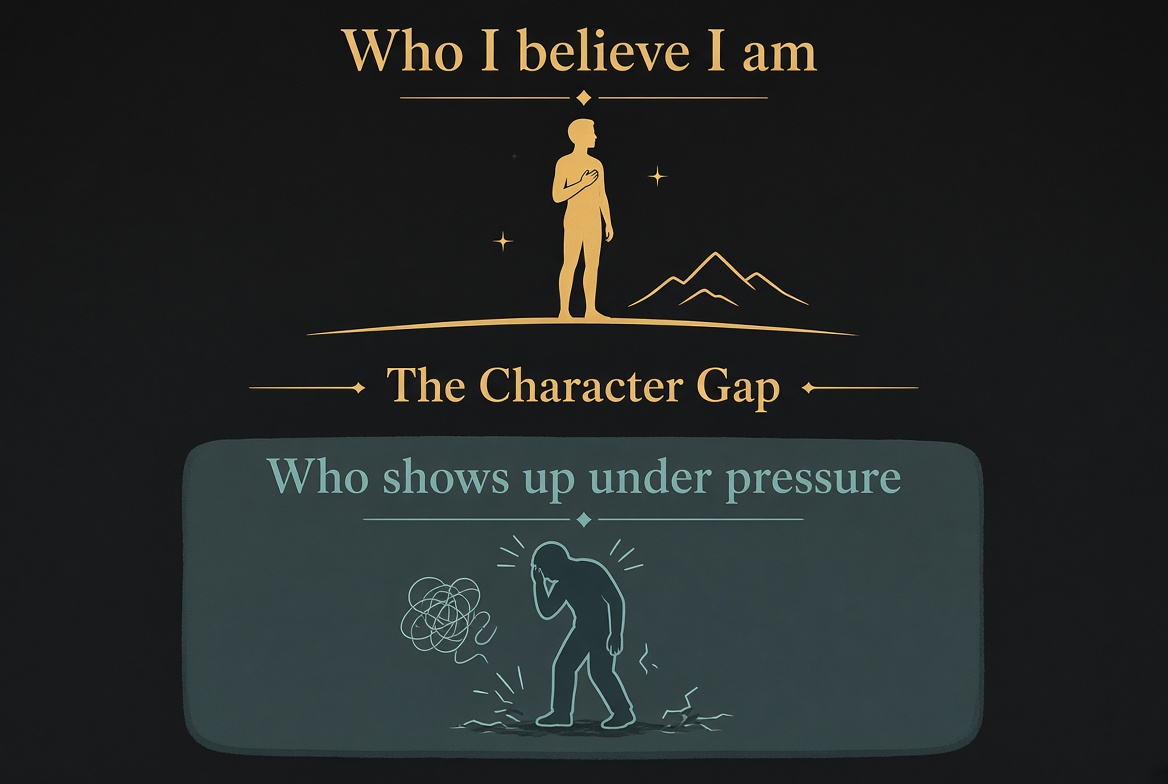
Grant and I spent time unpacking why that mixed picture feels so hard to accept. Most of us carry an internal story that we are basically good. The research suggests that story is inflated. We notice our good intentions more readily than our failures. We remember the times we helped and forget the times we looked away. Context does more of the heavy lifting than we like to admit.
The Black Friday scene is useful precisely because it is extreme enough to make the ordinary visible. Scarcity, competition, social momentum, and narrowed attention all pull against the impulse to stop. The same forces operate in smaller, quieter ways every day—when we walk past someone in need, stay silent in a group that is excluding someone, or prioritize convenience over care.
The Power of Context and Attention
One of the strongest threads in our conversation was the role of mindfulness—or the lack of it. Grant framed it well: before we can choose the virtuous response, we first have to notice that a choice is even available. Much of the time we move through the world on rails. The grocery list, the schedule, the social script keep us from registering the anomalous moment that asks something of us.
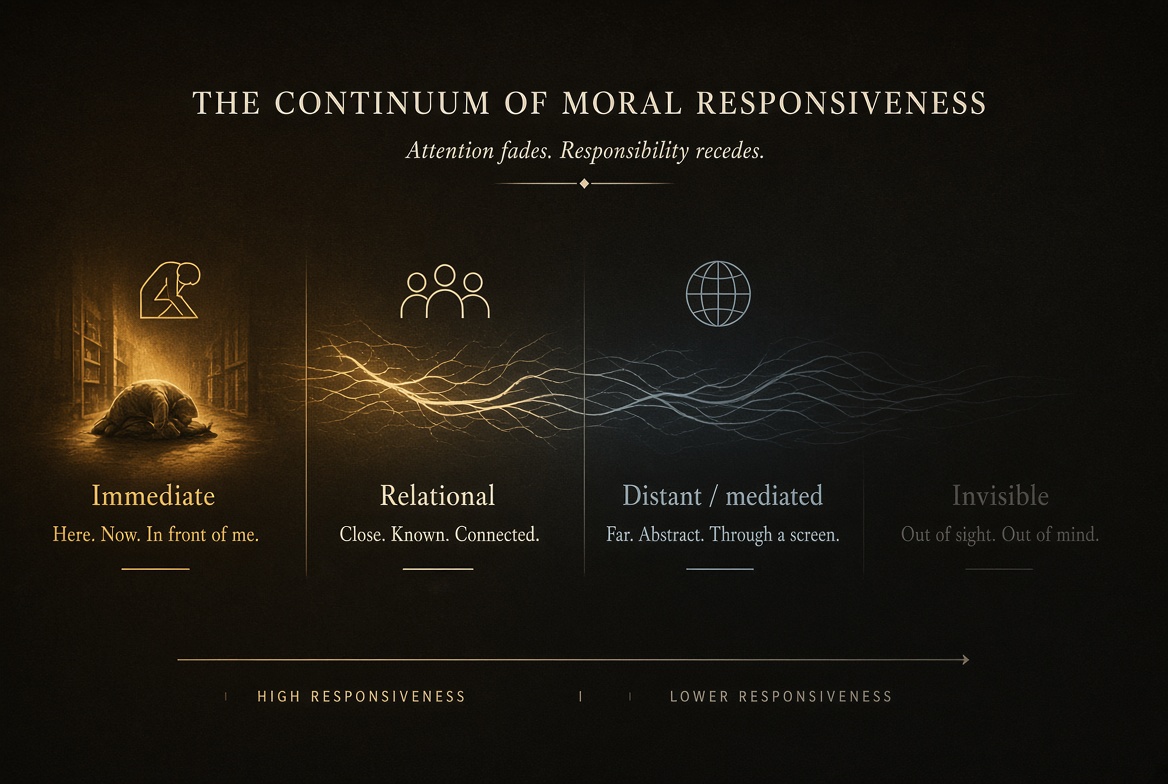
That observation reframes the classic thought experiments. Peter Singer’s drowning child is almost too clear. Almost everyone agrees they would ruin a nice suit to pull a child from a pond. The moral demand becomes murkier when the suffering is distant, mediated by institutions, or filtered through our own judgments about who “deserves” help. The further the person is from our immediate relational circle, the easier it becomes to distribute responsibility outward until it dissolves.
We also talked about how success and virtue get tangled in our culture. We often treat material achievement as evidence of character. That association is both inaccurate and corrosive. It makes it easier to walk past the person who is struggling and harder to question the systems that produce the struggle in the first place.
Moral Exemplars and the Problem of the Heroic Standard
Miller points to people like Mother Teresa and individuals who risked everything to hide Jewish families during the Holocaust. These figures can inspire. They can also become toxic measuring sticks. If the standard for “good character” is near-perfect consistency across every situation, then almost no one qualifies. The bar is set so high that ordinary moral effort starts to look like failure.
Grant pushed back on that heroic model. Character is not a single, all-or-nothing trait. Someone can be strong in compassion and weaker in courage, or strong in honesty and still struggle with temperance. The ideal is not a moral superhero who embodies every virtue at once. It is a more modest, ongoing practice of noticing, correcting, and staying in relationship.
This is where humility becomes central. The research does not prove we are bad people. It shows we are limited people who systematically overestimate our reliability. The useful response is not self-flagellation. It is a quieter form of honesty: I am probably not as consistent as I think I am, and that knowledge is worth carrying.
Character as Relational, Not Solo
Toward the end of the conversation we drifted into territory that felt especially alive. Grant described his own moral motivation not as a desire to be “a good person” in the abstract, but as an attempt to lead a good life within specific relationships and roles—husband, father, colleague, friend. That framing is closer to certain Confucian ways of thinking than to the isolated, autonomous self that dominates a lot of modern moral language.
I recognized something familiar in that. Character does not develop in a vacuum. It shows up—or fails to show up—inside systems: families, workplaces, men’s groups, classrooms, cycling clubs. Power dynamics and hierarchy are never neutral. They shape what counts as acceptable behavior and who gets to define the terms. Pretending a group has a “flat hierarchy” does not make the power disappear; it usually just hides it.
We talked about the limits of individual therapy as a complete answer to problems that are often systemic. Therapy can be genuinely helpful. It is not a substitute for the harder work of building communities that know how to do rupture and repair, that can talk honestly about status and abuse of power, and that resource people trained in restorative practices rather than simply telling the person who raises the red flag to “work on themselves.”
Personal Reflection
What stayed with me after talking with Grant is how ordinary the character gap feels once you stop treating it as a personal indictment. I have walked past people. I have stayed silent when speaking would have cost me social comfort. I have used the small authority I hold in ways that were more about efficiency than relationship. None of that makes me uniquely flawed. It makes me statistically normal.
The more useful question is whether I am willing to keep noticing. Whether I can stay curious about the moments when my self-image and my actual behavior diverge. Whether I can hold the research without collapsing into cynicism or inflating myself into an exception.
I also left thinking about the difference between performing goodness and practicing it. The performative version is exhausting and brittle. The practice version is slower, more local, and more honest about limits. It asks less for perfection and more for attention, repair, and the humility to keep showing up.
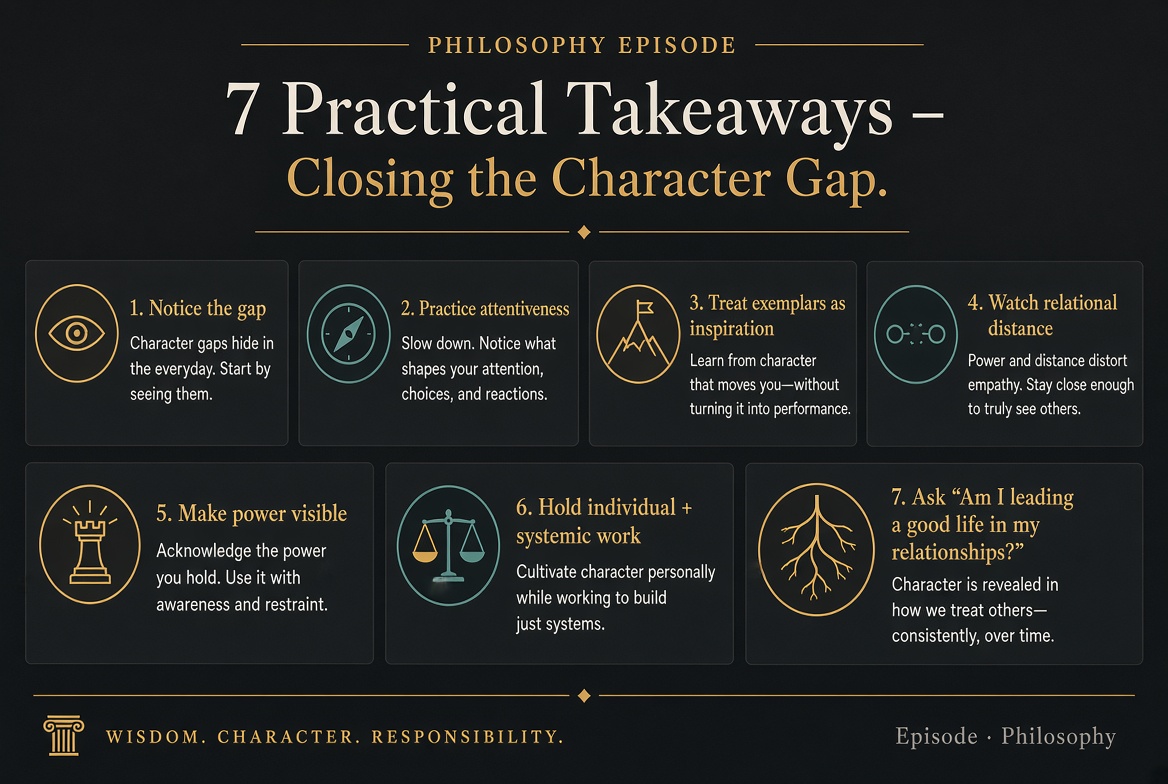
Practical Takeaways
- Notice the gap between the person you believe you are and the person who actually shows up under pressure. That gap is normal, not proof of unique failure.
- Practice attentiveness in ordinary settings. The ability to register an anomalous moment is the precondition for any moral choice.
- Treat moral exemplars as inspiration rather than rigid measuring sticks. Heroic standards often produce shame instead of growth.
- Pay attention to context and relational distance. The further someone is from your immediate circle, the easier it becomes to look away.
- Make power dynamics visible in the groups you belong to. Hidden hierarchy is usually more dangerous than acknowledged hierarchy.
- Hold both individual work and systemic work. Therapy can help the person; communities still need practices of accountability and repair.
- Prefer the question “Am I leading a good life in my actual relationships?” over the abstract question “Am I a good person?”
Conclusion
Miller’s central claim is not that we are bad. It is that we are mixed, and that most of us do not realize how mixed we are. The character gap is the space between our self-conception and our behavior under real conditions. Closing that gap is not a single conversion experience. It is the slower work of noticing, correcting, and remaining humble about how much situational force still shapes us.
Grant and I will continue through Parts Two and Three of the book. We also hope to bring Christian Miller into the conversation later. For now, the invitation from Part One is simple and demanding at once: look carefully at the distance between who you think you are and what you actually do when the aisle is crowded and the deal is good. That look is where the real work begins.
Guest Bio
Grant Potts is a distinguished faculty member at Austin Community College, specializing in Philosophy, Religion, and Humanities. Trained primarily as a scholar of religion, Grant is also a dedicated philosopher and curriculum developer, committed to promoting liberal education through the Great Question Foundation to benefit community college students of all disciplines. Outside the academic sphere, he is a passionate gardener, an enthusiastic hiker and cyclist, and an ardent tabletop roleplaying game enthusiast, delighting in adventures with friends and family in classics like Dungeons and Dragons as well as newer games like Coriolis and Forbidden Lands.
If This Resonated
These conversations explore similar themes.
The Good Life: Western vs Buddhist Philosophy with Grant Potts
The questions we avoid often shape the lives we end up living.
Finding Your Personal Legend in The Alchemist, Fate, Choice, and Meaningful Growth
Why The Alchemist Still Matters When You’re Trying to Figure Out Your Life