Most of us live inside a constant stream of thought. Planning, worrying, judging, rehearsing. We call it thinking. Sometimes it feels like the only voice available.
Father Bill W. suggests there is another voice. Quieter. Different in quality. Honest, pure, unselfish, and loving. Two-way prayer is the simple practice of making space to hear it, write it down, and begin a relationship with that deeper guidance.
In this follow-up conversation, we returned to the practice that has shaped Father Bill’s life for more than thirty years. What began as AA’s largely forgotten 11th Step has become, for him, a daily way of listening that works for anyone willing to try it—whether they are in recovery or simply tired of living only from the surface mind.
What Two-Way Prayer Actually Is
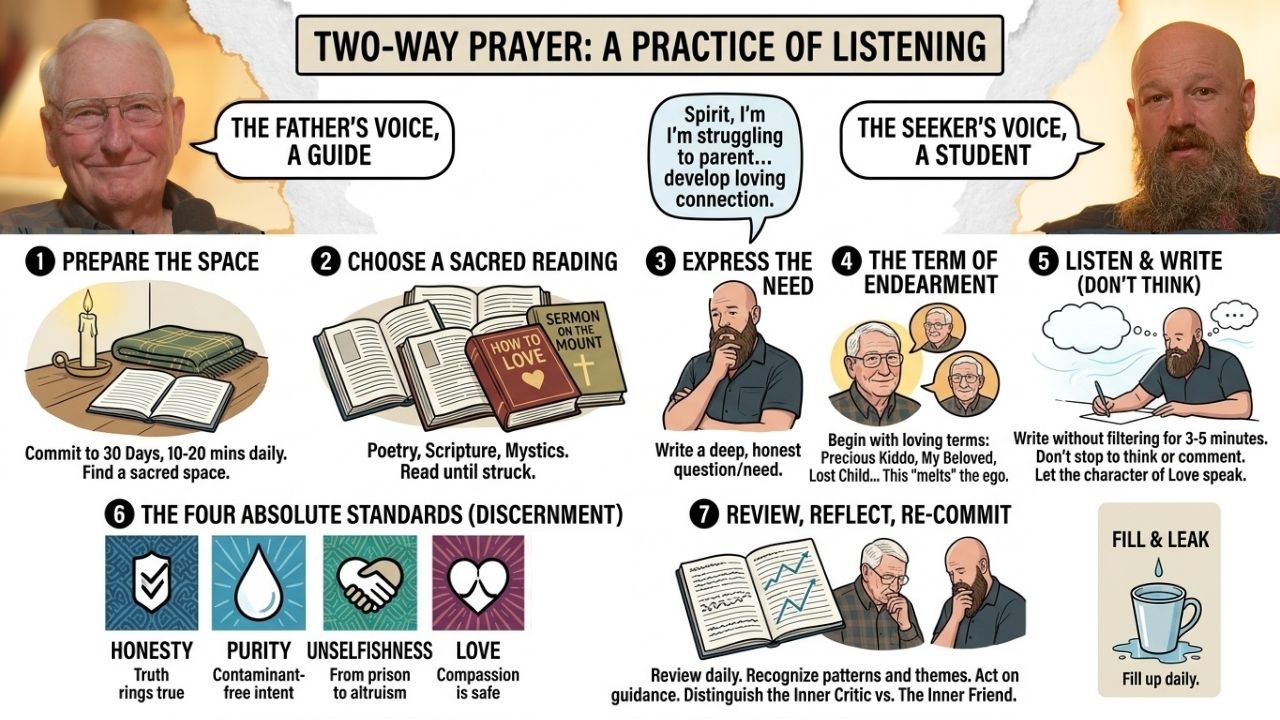
Two-way prayer is not about asking for things and hoping for answers. It is about listening. You quiet yourself, ask a sincere question or simply open to guidance, and then write what comes. The writing is essential. It creates a record. It slows the process enough that you can notice the difference in tone between the ordinary mental chatter and the quieter voice.
Father Bill is careful about discernment. The guidance that comes through this practice must meet four simple tests: it is honest, pure, unselfish, and loving. These standards, drawn from the Oxford Group that influenced early AA, protect the practice from wishful thinking or ego projection. You are not looking for race tips or personal advantage. You are looking for the voice that leads toward becoming more fully who you are meant to be.
He has practiced this every morning for over three decades. He rises earlier if needed, goes to a dedicated corner of his office, and sits with a journal. The consistency matters. One day’s guidance often becomes the next day’s question. Patterns emerge over time. The relationship deepens.
Why It Matters
Father Bill spent twenty years in recovery doing everything “right” and still feeling a quiet emptiness. Then he encountered the historical roots of AA and the practice of two-way prayer. It turned him around. The transformation was not dramatic in the theatrical sense. It was the steady experience of being met by a presence that offered stability, clarity, and unconditional regard.
He is clear that this is not therapy, though therapy can be valuable. Many people cannot access regular counseling. Two-way prayer offers a way of receiving guidance, love, and perspective that does not depend on another person’s schedule or a fee. It is self-help in the deepest sense—capital-S Self rather than the small-s ego self.
The practice is available to anyone. Its origins are connected to 12-step recovery, but its usefulness is not limited there. Anyone who has felt the limits of ordinary thinking can try listening for the other voice.
The Practice Itself
Father Bill walked through how the practice works in real time. You prepare a quiet space. You arrive with sincerity rather than performance. You may bring a specific question or simply open to whatever wants to be known. Then you write.
The samples he shared from workshops showed ordinary people, new to the practice, receiving simple, grounded, and surprisingly clear guidance. The tone is consistently different from ordinary self-talk—less frantic, more steady, oriented toward care rather than control.
Over days and weeks the practice begins to reveal patterns. Fears surface. Old stories loosen. Guidance given one morning becomes the material for the next. It is less a series of isolated messages and more an ongoing conversation that slowly reshapes how you meet your life.
Personal Reflection
What stayed with me is the ordinariness of the invitation. You do not need special states or dramatic experiences. You need a journal, a quiet corner, and the willingness to listen for a voice that is already present but usually drowned out.
I recognized the fear that arises when the guidance points toward greater trust or presence—especially with the people closest to us. The ego is quick to invent reasons not to listen. The practice does not eliminate that resistance. It simply gives you a daily place to notice it and bring it into the light.
I left the conversation committed to thirty days of the practice. Not as a project with a guaranteed outcome, but as an experiment in listening. The promise is not that every morning will produce profound insight. The promise is that a relationship can begin—one that slowly teaches you to recognize the difference between the voice that exhausts and the voice that steadies.
Practical Takeaways
- Create a dedicated time and place, preferably in the morning, for a short period of quiet writing.
- Approach the practice with sincerity rather than performance. Ask a real question or simply open to guidance.
- Write what comes without editing in the moment. Review it later for patterns.
- Test the guidance against the four standards: honest, pure, unselfish, and loving.
- Treat the practice as a relationship that builds over time rather than a source of one-off answers.
- Notice the difference in tone between ordinary mental chatter and the quieter voice. That difference is the signal.
- Commit to a stretch of consistent practice—thirty days is a useful starting point—so that patterns and continuity can emerge.
Conclusion
Two-way prayer is deceptively simple. Sit. Listen. Write. Return the next day. Over time the quieter voice becomes more familiar, and the louder one loses some of its automatic authority.
Father Bill W. has spent decades living this practice and sharing it with others. The invitation he extends is not to adopt a new belief system. It is to try listening for the voice that already knows how to guide you toward greater honesty, purity, unselfishness, and love. In a world full of noise, that listening itself becomes a form of quiet resistance and steady transformation.
Guest Bio
Father Bill W., an Episcopal priest, has dedicated over five decades to the field of addiction treatment, serving as a counselor, clinical director, and administrator. A University of Dayton history graduate with post-graduate work at Columbia University, he has a diverse background that includes the Peace Corps, working with orphaned children in the Bronx, life on a kibbutz in Israel, and involvement with the Catholic Worker Movement. He began his addiction work in Detroit as a Jesuit seminarian, achieving sobriety since 1972.
Awarded the Wheelock Whitney Award in 2008 for bridging faith and science in addiction recovery, he now concentrates on Two Way Prayer studies, with a website and podcast promoting the practice within 12-Step recovery. His podcast, “Father Bill W.,” has garnered a significant following, while he has led numerous workshops on Two Way Prayer.
Father Bill W. has authored articles on spirituality and AA history, conducted research on AA’s early prayer and meditation practices, and lectured as adjunct faculty on addiction and spirituality. Now retired, he volunteers to enhance addiction recovery through spiritual practices and reaches thousands with his workshops and bi-monthly newsletter. He is a husband, father of three, and grandfather of seven, residing near Austin, Texas.
Find Father Bill W.
- 🌐 Two-Way Prayer: TwoWayPrayer.org
- 🌐 Sam Shoemaker Community: SamShoemakerCommunity.org
- ▶️ YouTube: Father Bill W. Channel
- 🎙️ Podcast: Father Bill W. on Anchor
If This Resonated
These conversations explore similar themes.
Two-Way Prayer Practice for Inner Guidance, Healing the Inner Critic and Finding Clarity
Learning to trust the voice beneath thought, ego, and emotional noise
Finding the Inner Voice: Two-Way Prayer with Father Bill W.
Most of us spend our days inside a continuous stream of thought. Planning, worrying, rehearsing, judging. We call it thinking. Sometimes it feels like the on...